

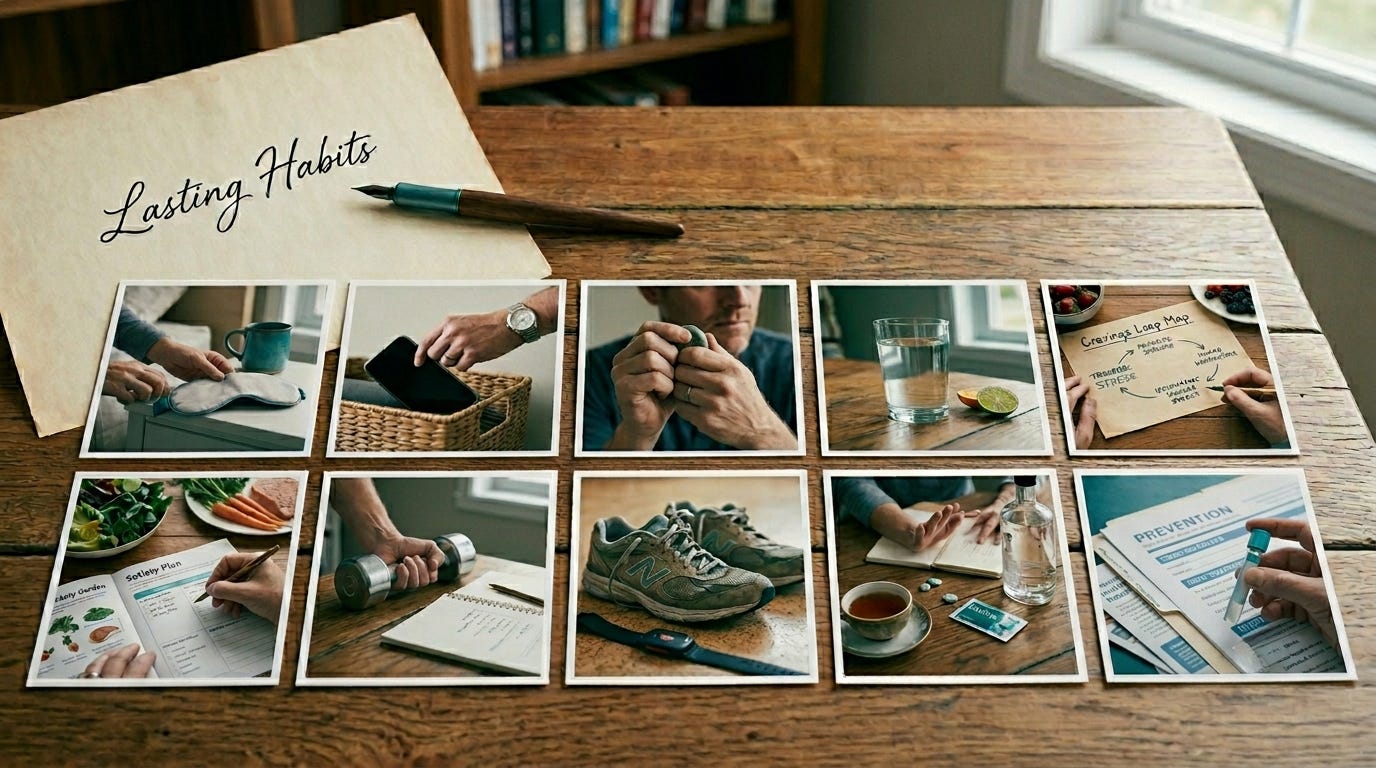
Welcome to the Lasting Habits Series
A once-a-week series of practical, doctor-designed health upgrades you can actually stick with.
Every Saturday, we’ll focus on one lever that makes everything else easier.
Here’s the roadmap:
Week 1 (sleep and recovery) explains how poor or fragmented sleep is often the real reason behind low mood, strong cravings, low energy, and feeling like you “lack willpower.” We covered why late nights and 3 a.m. wake-ups happen, how sleep regulates hunger, blood sugar, stress, and emotional resilience. The solution: a 7-day sleep reset plan, a step-by-step wind-down builder, troubleshooting guide for the most common patterns, and printable sleep reset toolkit.
Week 2 provides you screen boundaries and a brain protection plan. It explains how constant screen use trains the brain to stay in urgency and interruption mode, draining focus, impulse control, sleep, and emotional regulation. We talked about how screens overstimulate the stress system, exhaust the brain’s self-control center, worsen cravings and nighttime restlessness, and undo the benefits of better sleep. The solution: a step-by-step screen boundaries builder, a 3-part “phone rules” system, a dopamine-friendly replacement list, a troubleshooting guide for the most common problems, and a printable screen boundaries brain protection plan.
Week 3 is for people feeling wired, tired, and on edge. It explains why many people feel unable to relax even when nothing is “wrong”: their nervous system is stuck in a half-activated stress state from constant, low-grade demands. We talked about how chronic stress load builds up in the body, disrupting mood, sleep, cravings, and focus, and why this isn’t a willpower issue but a recovery problem. The solution: step-by-step stress resilience reset, a “turn off the alarm” strategy, the 3 most effective nervous system levers (and how to use them depending on your stress type), a stop-the-spiral protocol, and a printable nervous system reset plan you can keep visible—so you don’t have to remember what to do when you’re overwhelmed.
Week 4 covers how aging accelerates when you’re dehydrated (which is most common than people think). It explains how chronic, mild under-hydration can disrupt brain function, digestion, energy, and cravings—and may even be linked to accelerated aging over time. We talked about why thirst is an unreliable signal, how hydration hormones influence metabolic and cardiovascular stress, and why many “I feel off” symptoms improve when fluid intake is stabilized.
Today’s post: Big Food’s traps, why cravings hit, and how to take back control—so you can feel free again, for good.
Upcoming posts:
Week 6 shows how one simple habit has shaped human survival, from scurvy prevention in the 1700s to wartime “Victory Gardens.” You’ll discover about how fruits and vegetables stabilize appetite hormones, steady blood sugar, support gut–brain signaling, and are linked to lower risks of cardiovascular disease, cancer, depression, and early mortality. The solution: a personalized Mood and Satiety Plan designed around your goals, cravings, schedule, and real-life constraints. You answer targeted questions, and you receive a clear, practical plan that fits your day—so mood feels steadier and meals more satisfying without dieting.
Week 7 reframes strength as independence insurance, the habit that protects your ability to carry groceries, climb stairs, lift suitcases, and keep saying yes to normal life as you age. We’ll talk about how resistance training strengthens not just muscles but your nervous system, balance, mood stability, and long-term health. The solution: a step-by-step Lasting Strength Setup based on adherence strategies that showed promise in randomized controlled trials.
Week 8 shows that it’s never too late to rebuild your cardiovascular engine. Through the story of 92-year-old marathon finisher Mathea Allansmith, we talked about how cardio remains trainable at any age and why longevity depends more on consistency than intensity. The key idea: cardio helps you live longer, strength helps you live better—and the real challenge is building habits that survive real life. The solution: a practical Fitness Tracker that helps you define your starting point, set clear goals, track workouts, steps, body measurements, progress photos, and 30-day and 12-week challenges—so cardio and strength become a routine you can rely on.
Week 9 shows how repeated habits with alcohol and nicotine reshape your sleep, stress response, and reward system over time. Your brain learns the loop stress → substance → relief → repeat. Over time, that loop can destabilize mood, recovery, appetite, and long-term health. The solution: a simple 7-Day “Remove the Saboteurs” Experiment designed to reset your baseline. By testing small boundaries you interrupt the automatic cue-relief cycle and observe how sleep, mood, and cravings shift when your nervous system finally gets a steadier foundation.
In week 10 we talk about how prevention and early detection can dramatically change health outcomes, from removing precancerous polyps before cancer forms to reversing prediabetes and protecting brain, heart, and bone health long before damage becomes irreversible. The solution: knowing which preventive tests matter and monitoring key risk factors early. Combined with the daily habits from this series, these screenings give you the leverage to detect problems early, reverse risks sooner, and protect the decades ahead instead of reacting when disease finally shows symptoms.
If you’re done managing symptoms on repeat, you’re in the right place. This is the habit foundation most people never get.
Week 5: Big Food Doesn’t Want You to Read This
Because it frees you from them.
Millions of people get stuck in the same loop:
We start with a “good” breakfast, but then we have a busy day, a stressful afternoon, and then… the pantry opens like it’s magnetic. And it’s not a magnet for food, it’s for relief.
We eat food like pills. A dessert for stress, a processed snack for fatigue, chips for “I deserve something,” or sweets for “I can’t deal with one more thing.”
And you’re probably telling yourself you need more discipline, motivation, etc.
However, your cravings are a brain response to a food environment that’s been engineered to win.
Big Food’s job is to sell more units, and the easiest way to do that is to create products that make you want “just a little more.”
That’s the business model.
And if you’ve ever felt like certain foods “turn on autopilot”… you’re definitely not alone. That’s happened to me too, especially during stressful seasons, and I see it constantly in patients.
So today, I’m here, with you.
Changes in Portion Sizes in Recent Decades
Big Food makes it more difficult to resist their trap every year.
Marketplace portions of foods that are major contributors of energy to US diets have increased significantly since the 1970s and exceed federal standards for dietary guidance and food labels.1

With the single exception of sliced white bread, all of the commonly available food portions measured in a study exceeded (sometimes greatly) USDA and FDA standard portions.1
The largest excess over USDA standards (700%) occurred in the cookie category, but cooked pasta, muffins, steaks, and bagels exceeded USDA standards by 480%, 333%, 224%, and 195%, respectively. This observation also holds for french fries, hamburgers, and soda, for which current sizes are 2 to 5 times larger than the originals.
Wait a Minute: Am I Eating a Portion or a Serving (A Common Mistake)
It’s common to confuse “portion” and “serving,” but understanding these differences is vital to balanced eating.
A portion is the amount of food you eat once, while a serving is the amount recommended by nutritional guidelines to maintain a healthy diet.
This distinction is especially important when eating out or shopping at the supermarket. What’s served in a restaurant may contain several servings, even if we perceive it as a single portion. The same happens with packaged products, often much larger than the recommended servings.
For example:
A 20-ounce (591 mL) soda, which many people consume as a single portion, actually contains 2.5 servings.
A 3-ounce (85 g) bag of potato chips may seem like a single portion, but it contains 3 servings.
This kind of misinformation leads to overeating without realizing it, affecting our health and weight management.
To handle this, it’s essential to know how to read the Nutrition Facts labels on packaged foods, which indicate how many servings are in a package.
This equips you with the knowledge to better adjust your daily portions and improve your relationship with food, making healthier choices.
How to Read the Nutrition Facts Labels on Packaged Foods
The Nutrition Facts label is mandatory on foods and beverages in many countries. It offers details about nutrient content such as calories, fats, sugars, proteins, vitamins, and minerals per serving.
This panel is useful for comparing products and choosing foods that align with your goals. For instance, if you aim to control your intake of sugars or saturated fats or increase your consumption of calcium and vitamin D, this panel will be valuable.
1) Serving size information
Serving size appears first on the Nutrition Facts panel because all subsequent information depends on that quantity. It reflects what is typically consumed in one sitting, and the nutritional values shown are based on this specific amount.
Additionally, the number of servings per container is also indicated.
Remember that serving sizes on labels only sometimes reflect what you’ll consume. Some manufacturers indicate smaller portions to make the product appear healthier; for example, a soda bottle may list two servings, even though it’s typically consumed all at once.
2) Calorie information
This section shows the amount of energy provided by one food serving.
3) Nutrient amounts
Labels must include the amounts of the following essential nutrients: total fat, saturated fat, trans fats, cholesterol, sodium, carbohydrates, dietary fiber, sugars, added sugars, protein, calcium, vitamin D, iron, and potassium.
Manufacturers may also choose to add additional nutritional information, such as calories from saturated fat, polyunsaturated and monounsaturated fats, soluble and insoluble fiber, sugar alcohols, other carbohydrates, and other vitamins and minerals.
4) Percent Daily Value (%DV)
The %DV helps you understand how a serving contributes to the recommended daily intake of each nutrient. To use it effectively, follow these simple guidelines:
• 5% DV or less per serving is considered low, ideal if you’re trying to limit nutrients like saturated fat, cholesterol, sodium, or added sugars.
• 20% DV or more per serving is considered high, valid for nutrients you want to increase, such as calcium or vitamin D.
The %DV is a handy tool for quickly comparing similar products. For instance, when deciding between two salad dressing brands, you can opt for the one with a lower %DV for sodium and added sugars.
Pros:
Detailed information: Provides a thorough overview of key nutrients, such as calories, fats, proteins, and vitamins
Facilitates comparisons: Helps consumers make informed decisions by comparing products in terms of specific nutrients
Cons:
Misleading serving sizes: Indicated portions may not reflect what people actually consume, potentially distorting the perception of nutrient intake
Does not consider ingredient quality: Only lists numerical values without context about processing
Portion Distortion or the “Normalizing Effect”
The constant exposure to larger portions alters our perception of what we consider a “normal portion.”
This phenomenon is called portion distortion or the “normalizing effect,” where oversized portions are perceived as standard. It can lead to higher-than-necessary calorie consumption, making it harder for people to identify and eat healthy portions.
You might wonder:
“Will I prevent this “normalizing effect” if I just eat smaller portions?”
Let me present you with two hypotheses—guess which one is correct!
• Hypothesis 1: We “compensate” for the reduction in portion sizes by eating more at subsequent meals.
• Hypothesis 2: We don’t “compensate” with later snacks, and we end up losing weight.
Research on the first hypothesis is limited. One study found that reducing the portion size of a main course at lunch decreased the calorie intake for that dish but increased the energy consumption from dessert.2
However, a systematic review and meta-analysis of various studies on portion size manipulation showed that eating smaller portions reduces daily calorie intake, which can, over time, contribute to body weight loss.3
Therefore, hypothesis 2 appears to be the winner: reducing portion sizes could be a simple and effective strategy for losing weight.
Good news!
Ayurveda and Portion Sizes
In Ayurveda, an ancient healing system that originated in India over 5,000 years ago, food portions play a key role in balancing the doshas (Vata, Pitta, and Kapha), the internal energies that govern the body.
Each person’s unique combination of doshas determines which foods and portion sizes are most suitable for their well-being. The amount of food consumed should be adjusted according to each person’s dominant dosha, energy needs, digestive capacity (Agni), and external factors such as the climate or season.
It highlights the importance of portion sizes.
Simply consuming an extra 100 calories daily can translate into a weight gain of approximately 11 pounds (5 kilograms) over a year.
The increase in portion sizes has been directly linked to the growing obesity epidemic, especially in the United States. Since 1988, the adult obesity rate has doubled4 to the point where, today, more than 2 out of 5 Americans are obese.5
A study revealed that when people are served larger portions of food, they tend to eat more regardless of their hunger level.6
Your Two “Eating Brains” Fighting the Food Industry
Your eating decisions are controlled by two overlapping systems, and they don’t always agree.
Think of it like having two departments trying to run the same company:
One is focused on stability and survival (fuel, balance, “enough”)
The other is focused on learning and reward (“remember this,” “repeat this,” “this helped”)
Ultra-processed food tends to give one of them a megaphone.
1) Homeostatic System (True Hunger + Fullness)
This is your body’s energy regulation system.
If your body were a car, this system is the one checking:
Fuel gauge
Engine temperature
Dashboard warnings
Whether you actually need to stop at the next gas station
It answers questions like:
Do we truly need energy right now?
Have we had enough?
Where This Lives
This system is run mainly through:
The hypothalamus (deep in the brain—your energy control center)
The gut (your hormone factory and sensor system)
The bloodstream (the data highway that carries those signals)
What Signals It Uses (Simple Explanation)
A) Your stomach’s stretch sensors
Your stomach has stretch receptors that send “space is filling up” signals through nerves (including the vagus nerve) to the brain.
That’s why volume matters.
B) Gut hormones that act like text messages to the brain
After you eat, your small intestine releases hormones like: GLP-1, PYY and CCK.
They slow things down, reduce appetite, and communicate: “We’re getting fed. You can ease off.”
C) Blood sugar and energy availability
Your brain pays attention to whether your energy is steady or dropping, because a drop feels urgent.
D) Leptin (long-term fuel storage signal)
Leptin is produced by fat tissue and signals longer-term energy status. When the body feels it has enough stored energy, leptin helps reduce drive to eat (in a healthy system).
What It Feels Like
This system is SLOW. It’s the one that says:
“I’m hungry.”
“I’m satisfied.”
When you’re eating mostly minimally processed foods (protein, fiber, whole foods) this system tends to work beautifully because the signals are clear and the pace is natural.
2) The Reward System (Dopamine + Learned Patterns)
This is your brain’s motivation, learning, and repetition system. If the home system is your fuel gauge, the reward system is your brain’s “bookmark” button.
It asks:
Was this worth repeating?
Did this change my mood fast?
Did this relieve stress?
Should I go get it again?
Where This Lives
This system is driven through circuits involving:
The dopamine pathway (motivation/drive signal)
The striatum / nucleus accumbens (habit + reward learning)
The amygdala (emotional tagging: “this helped me feel better”)
Memory networks that link food with time, place, and emotion
The Dopamine Part (Important Reframe)
Dopamine is often called the “pleasure chemical,” but that’s not the best way to understand it.
Dopamine tells your brain: “Pay attention. This matters. Remember it. Repeat it.” That’s why cravings can show up even when you’re not hungry.
Cravings are often: memory + emotion + cue.
What It Feels Like
This system is FAST. It shows up as:
Urgency
“I need something”
A pull toward a specific food
The feeling of “not satisfied until I have that”
And cues can trigger it instantly: the couch, the car, the pantry, after dinner, after a stressful email, at 3 p.m., when you’re tired, when you’re lonely, when you want comfort…
How Ultra-Processed Foods Tilt the Balance
Ultra-processed foods speak louder to your reward circuitry than to your satiety circuitry, and they do it fast.
On the “regulation” side, fullness is a delayed biological signal:
Your stomach needs time to stretch, your small intestine needs time to release satiety hormones (like GLP-1, PYY, and CCK), and your brain needs time to integrate that information in hypothalamic and brainstem circuits.
Ultra-processed foods often bypass that timing advantage by being energy-dense and easy to eat quickly—less chewing, faster swallowing, and a high calorie “payload” per minute—so you can overshoot true satiety before your body’s stop signals fully arrive.
At the same time, these foods are engineered to activate reward learning:
The combination of refined carbohydrates + added fats + salt + flavorings and texture (crunch, melt, creaminess) creates an intense, repeatable sensory signal that dopamine circuits treat as “important—remember this.”
Over repeated exposures, your brain starts linking that reward with cues (time of day, stress, the couch, the pantry), so the urge can appear before hunger (a learned prediction rather than a fuel need).
The result is a predictable mismatch:
The slower homeostatic system is still trying to regulate energy, while the faster reward system is pulling you toward “more,” especially when you’re tired, stressed, or distracted—states that reduce prefrontal control and amplify the brain’s preference for immediate relief.
But… How Do We Know if a Food Is Ultra-Processed?
In our fast-paced world, convenience often trumps nutrition, leading to a growing reliance on ultra-processed foods.
The NOVA classification system, developed by researchers at the University of São Paulo, categorizes foods into four groups based on their level of processing.7,8
These are:
1) Unprocessed or minimally processed foods
Such as fresh fruits, vegetables, legumes, and whole grains.
2) Processed culinary ingredients
These include oils, salt, sugar, and butter, which are used for cooking.
3) Processed foods
This category includes canned vegetables, fruits, simple breads, and cheeses.
Although these are generally made with natural ingredients, they may contain added salt, sugar, or preservatives to extend their shelf life.
4) Ultra-processed foods
Ultra-processed foods are industrial products, generally formulated with five or more ingredients, containing little to no whole foods.
They are characterized by additives, flavorings, and colorings that enhance their palatability and sensory properties, making them unrecognizable compared to the original ingredients they contain.
As a result, they are foods that are especially high in calories, salt, sugar, saturated fats, and trans fats, but low in protein, fiber, and micronutrients.
These products include a wide variety of foods, such as sodas, energy drinks, sugary beverages, packaged sweet or salty snacks, ice cream, chocolates, candies (confectionery), cookies, cakes, processed cheeses, reconstituted meat products, instant soups and noodles, and ready-to-eat or heat-and-serve meals.
Understanding this classification helps us distinguish between healthier options and those we should eliminate.
“I Feel Out of Control Around Certain Foods.”
If that happens to you, then, you definitely need to read this post:

Your Free “Autopilot Interrupt”: The 10-Minute Pause
When a craving hits, do 10 minutes before deciding to let your physiology catch up.
Drink water (or herbal tea).
If you might truly be hungry, eat a protein-forward option first (even small): eggs, Greek yogurt, tuna, edamame, cottage cheese, leftovers, a protein shake—anything realistic.
Wait 10 minutes.
Then ask:
“Do I still want it—or do I want relief?”
“If I eat it, will I plate it?”
(Plated = choice. Bag/box = autopilot.)
This pause restores the thing ultra-processed food steals:
a moment of decision.
Cravings Off Autopilot: Take Control Again
If the “autopilot” part of this post felt familiar, or if you’re tired of getting pulled into Big Food traps, the next section is where we build your personal plan so cravings stop running the show.
Today, you’ll get:
The Craving Loop Map: Identify your main driver in minutes—stress, fatigue, blood sugar dips, boredom, habit—so you use the right fix instead of guessing (and failing).
Troubleshooting for the most common patterns, so you don’t get stuck when real life shows up: “I’m fine all day… then I lose it after dinner,” “I crave sweets every day,” “I crave crunchy/salty all the time,” “I snack even when I’m not hungry,” “Once I start, I can’t stop,” and “I know what to do… but I don’t do it.”
A printable 7-Day Autopilot Breaker (step-by-step): Small daily moves that retrain your default without strict diets, complicated tracking, or “perfect” weeks.
The Satisfaction Upgrade: Most plans fail because they’re missing one thing: enjoyment. Every Sunday, starting tomorrow, I’m sharing flavor-first, high-satiety recipes—so you don’t rely on willpower and your plan is one you actually want to repeat. Tomorrow’s recipe is my favorite dish from Spain (where I’m from): pure Mediterranean comfort, designed to work anywhere you live.
New Schedule
Monday to Friday: a quick, practical tip you can read in a minute (suitable for busy people or busy days), grounded in the most solid and recent evidence.
Saturday: a full-length deep dive with a clear takeaway + implementation.
Sunday: mouth-watering recipes brought from a Medical Doctor with a Master of Science in Nutrition.
Unlock today’s plan and start seeing changes right away. Upgrade now.