

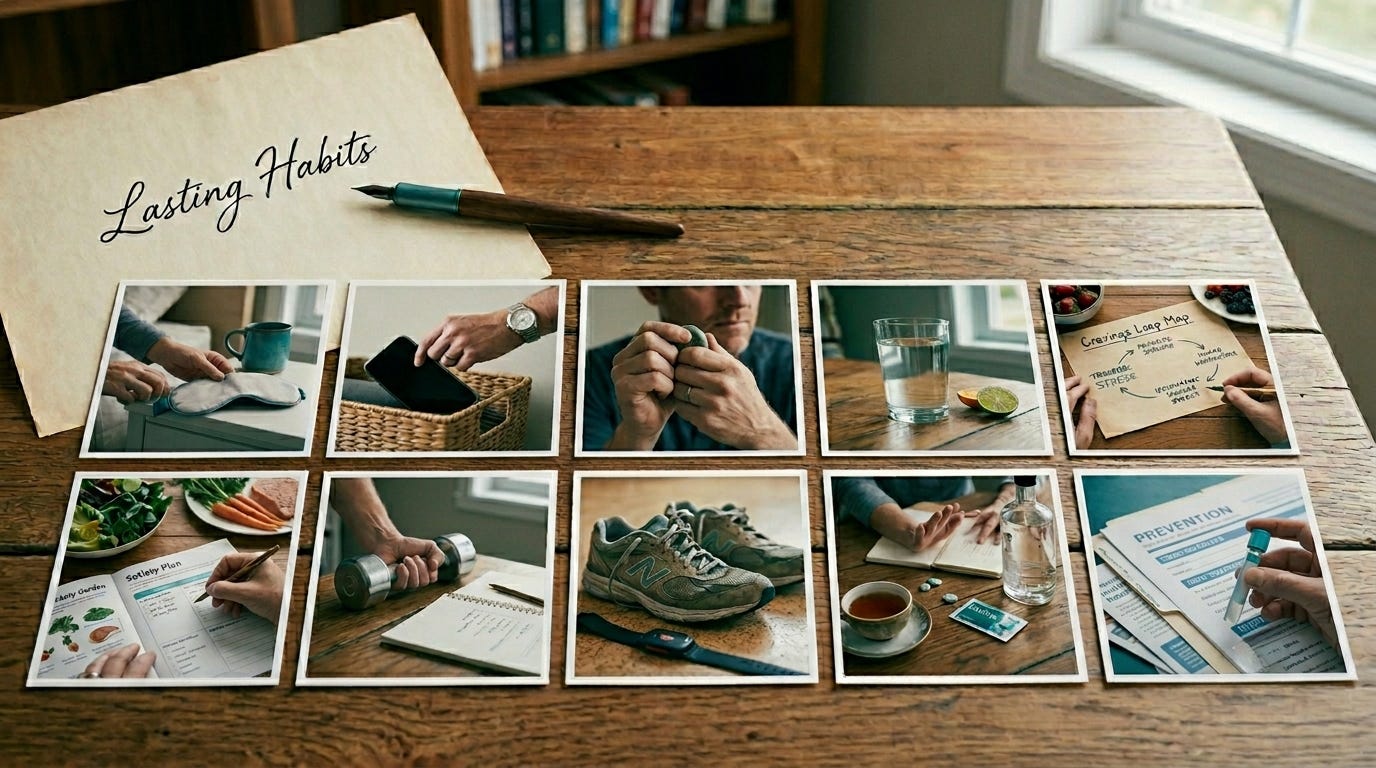
Welcome to the Lasting Habits Series
A once-a-week series of practical, doctor-designed health upgrades you can actually stick with.
Every Saturday, we’ll focus on one lever that makes everything else easier.
Here’s the roadmap:
Week 1 (sleep and recovery) explains how poor or fragmented sleep is often the real reason behind low mood, strong cravings, low energy, and feeling like you “lack willpower.” We covered why late nights and 3 a.m. wake-ups happen, how sleep regulates hunger, blood sugar, stress, and emotional resilience. The solution: a 7-day sleep reset plan, a step-by-step wind-down builder, troubleshooting guide for the most common patterns, and printable sleep reset toolkit.
Week 2 provides you screen boundaries and a brain protection plan. It explains how constant screen use trains the brain to stay in urgency and interruption mode, draining focus, impulse control, sleep, and emotional regulation. We talked about how screens overstimulate the stress system, exhaust the brain’s self-control center, worsen cravings and nighttime restlessness, and undo the benefits of better sleep. The solution: a step-by-step screen boundaries builder, a 3-part “phone rules” system, a dopamine-friendly replacement list, a troubleshooting guide for the most common problems, and a printable screen boundaries brain protection plan.
Today’s post:
Week 3 is for people feeling wired, tired, and on edge. It explains why many people feel unable to relax even when nothing is “wrong”: their nervous system is stuck in a half-activated stress state from constant, low-grade demands. We talked about how chronic stress load builds up in the body, disrupting mood, sleep, cravings, and focus, and why this isn’t a willpower issue but a recovery problem. The solution: step-by-step stress resilience reset, a “turn off the alarm” strategy, the 3 most effective nervous system levers (and how to use them depending on your stress type), a stop-the-spiral protocol, and a printable nervous system reset plan you can keep visible—so you don’t have to remember what to do when you’re overwhelmed.
Upcoming posts:
Week 4 covers how aging accelerates when you’re dehydrated (which is most common than people think). It explains how chronic, mild under-hydration can disrupt brain function, digestion, energy, and cravings—and may even be linked to accelerated aging over time. We talked about why thirst is an unreliable signal, how hydration hormones influence metabolic and cardiovascular stress, and why many “I feel off” symptoms improve when fluid intake is stabilized.
Week 5 breaks down why cravings aren’t a discipline failure but a predictable brain response to an ultra-processed food environment designed to keep you on autopilot. We talked about how portion distortion, misleading serving sizes, and hyper-reward foods hijack the brain’s reward system faster than true hunger signals can respond—especially when you’re stressed, tired, or distracted. The solution: a craving loop map to identify your main driver in minutes so you use the right fix instead of guessing (and failing), a troubleshooting guide for the most common patterns, and a printable 7-day autopilot breaker (small daily moves that retrain the default).
Week 6 shows how one simple habit has shaped human survival, from scurvy prevention in the 1700s to wartime “Victory Gardens.” You’ll discover about how fruits and vegetables stabilize appetite hormones, steady blood sugar, support gut–brain signaling, and are linked to lower risks of cardiovascular disease, cancer, depression, and early mortality. The solution: a personalized Mood and Satiety Plan designed around your goals, cravings, schedule, and real-life constraints. You answer targeted questions, and you receive a clear, practical plan that fits your day—so mood feels steadier and meals more satisfying without dieting.
Week 7 reframes strength as independence insurance, the habit that protects your ability to carry groceries, climb stairs, lift suitcases, and keep saying yes to normal life as you age. We’ll talk about how resistance training strengthens not just muscles but your nervous system, balance, mood stability, and long-term health. The solution: a step-by-step Lasting Strength Setup based on adherence strategies that showed promise in randomized controlled trials.
Week 8 shows that it’s never too late to rebuild your cardiovascular engine. Through the story of 92-year-old marathon finisher Mathea Allansmith, we talked about how cardio remains trainable at any age and why longevity depends more on consistency than intensity. The key idea: cardio helps you live longer, strength helps you live better—and the real challenge is building habits that survive real life. The solution: a practical Fitness Tracker that helps you define your starting point, set clear goals, track workouts, steps, body measurements, progress photos, and 30-day and 12-week challenges—so cardio and strength become a routine you can rely on.
Week 9 shows how repeated habits with alcohol and nicotine reshape your sleep, stress response, and reward system over time. Your brain learns the loop stress → substance → relief → repeat. Over time, that loop can destabilize mood, recovery, appetite, and long-term health. The solution: a simple 7-Day “Remove the Saboteurs” Experiment designed to reset your baseline. By testing small boundaries you interrupt the automatic cue-relief cycle and observe how sleep, mood, and cravings shift when your nervous system finally gets a steadier foundation.
In week 10 we talk about how prevention and early detection can dramatically change health outcomes, from removing precancerous polyps before cancer forms to reversing prediabetes and protecting brain, heart, and bone health long before damage becomes irreversible. The solution: knowing which preventive tests matter and monitoring key risk factors early. Combined with the daily habits from this series, these screenings give you the leverage to detect problems early, reverse risks sooner, and protect the decades ahead instead of reacting when disease finally shows symptoms.
If you’re done managing symptoms on repeat, you’re in the right place. This is the habit foundation most people never get.
Week 3: Why You Can’t Relax (Even When Nothing’s Wrong)
We talk about stress like it’s a switch:
“I’m stressed.”
“I need to relax.”
On. Off.
But your biology doesn’t work like that.
It’s supposed to surge, then drop… surge, then drop.
Like a wave.
You see it clearly in a healthy cortisol curve:
High in the morning → get up, think, act
Low at night → repair, digest, sleep
When life is intense but recoveries are intact, your stress system behaves like an athlete doing intervals.
Up. Down. Up. Down.
Modern life breaks that rhythm.
It pins you halfway on:
A weird email
A tense conversation
A notification bar that never sleeps
A calendar packed 100% of the time
“Just a minute” of scrolling that turns into 40
Individually, those things look small.
But your nervous system measures load.
You end up in a state I call stuck stress:
Not calm
Not in crisis
Just… half-activated all day
Not enough to sprint, but enough to feel on edge, tired but wired, easily overwhelmed, reactive, snacky for no clear reason, exhausted at bedtime… but unable to truly shut down.
That’s your nervous system saying:
“I’ve been on duty too long without a real off-switch.”
The Health Backpack You’ve Been Carrying for Years
Your body runs on two master modes:
1) Threat Mode (Gas Pedal)
This is your survival gear.
Heart rate up
Blood pressure up
Blood sugar ready
Focus narrowed
Stress hormones (like cortisol) in play
Perfect when something actually demands rapid action.
2) Repair Mode (Brake + Pit Stop)
This is where the good stuff happens:
Deep tissue repair
Hormone balance
Immune regulation
Stable mood
Digestive function
Deep, restoring sleep
You need oscillation between the two to grow, heal, or truly regulate.
The problem is never fully completing the cycle—living with the gas pedal slightly pressed all the time, and the brake never fully engaged.
In medicine, we have a name for the bill you pay for that state: allostatic load.
It’s the wear and tear we can measure in your body over time:
Blood pressure patterns
Inflammatory markers
Blood sugar regulation
Abdominal fat
Heart-rate variability
Cortisol rhythm (that curve that should be high in the morning and low at night)
Higher allostatic load = your body has been carrying a heavy backpack for too long.
And that backpack is directly tied to higher risk of:
Cardiovascular disease
Metabolic disease
Depression and anxiety
Cognitive decline
Remember: a higher allostatic load is linked with long-term health decline.¹
Low-Battery Brain
Here’s the part people don’t realize:
When stress is chronic, your brain starts behaving like your phone on low battery.
You can still function… but your system becomes glitchy:
You lose focus faster
You get irritated faster
You crave quick comfort more
You tolerate less friction
You make decisions you wouldn’t make on a “good brain day”
This is why stress shows up as:
More cravings: Your brain starts hunting for fast relief (sugar, scrolling, snacks, dopamine).
Worse sleep: Your body doesn’t switch into repair mode easily, so your mind keeps running at night.
Mood volatility: Small problems feel big, because your baseline is already elevated.
And a long list of etceteras.
The Good News: Your Body (and Mind) Can Be Trained Back to Calm
Here’s the part most people never hear from a doctor:
Your stress system is adapted to the signals you’ve been giving it. And it can adapt back. Not with a life that has zero stress—that doesn’t exist. And not with “more willpower.”
With signals.
Small, repeated signals that tell your body:
“You can stand down now. We’re safe.”
Think of them as micro off-switches you practice every day:
Certain kinds of breathing that increase your vagal “brake”
Specific types of movement that discharge tension without exhausting you
Deliberate “no-input” moments for your senses
Rituals that teach your body when the workday is truly over
A large systematic review and meta-analysis of randomized trials in adults found multiple wellbeing interventions improve outcomes, including mindfulness-based approaches, yoga, and exercise (with combined approaches showing the strongest effects).²
And studies show that stress-management interventions can even shift cortisol patterns (your stress hormone) in measurable ways—especially mindfulness and relaxation-based approaches.⁴
Translation:
You do NOT need a perfect life to feel better.
You need a nervous system that remembers how to switch gears again.
And that’s what Week 3 is about.
The 60-Second Downshift
If stress has been living in your body lately, start here, with a reset you can do in the middle of real life—in your car, in the bathroom, between meetings, before you open your phone.
Do 6 rounds:
Inhale through your nose for 4 seconds
Exhale slowly for 6 seconds
Repeat 6 times
That’s about 60 seconds (each round = ~10 seconds).
Why This Works (The Real Physiology, Simplified)
When you’re stressed, your body shifts into a high-alert state driven by your sympathetic nervous system.
That state changes several things at once:
Your heart beats faster
Your breathing becomes quicker and more shallow
Your muscles hold more tension
Your brain becomes more threat-focused (“scan for problems”)
The key point is this:
Breathing is one of the only body functions that is both automatic AND under your control.
So when you change your breathing pattern, you can change your nervous system state.
Here’s what the 4–6 breathing pattern does:
1) A Longer Exhale Activates Calming Pathways
A slow, longer exhale increases activity of the parasympathetic nervous system (especially through the vagus nerve).
This is the system that supports recovery: digestion, repair, and emotional regulation.
2) It Changes Your Heart Rhythm in a Measurable Way
Slow breathing increases heart rate variability (HRV), which is basically your body’s flexibility under stress.
Higher HRV is generally associated with better stress resilience and better emotional regulation.
3) It Reduces “Over-Breathing” and Stress Chemistry
When people are anxious, they often breathe too fast or too shallow without noticing.
That can lower carbon dioxide levels and make symptoms worse (lightheadedness, tension, racing heart, panic sensations).
Slowing the breath helps reverse that pattern.
4) It Tells Your Brain: “We’re Not in Danger Right Now”
Your brain constantly uses body signals to decide how safe you are.
When breathing becomes slower and more controlled, the brain updates the threat level downward.
That’s why this works even when your life is still stressful.
What You Should Notice When It’s Working
After 6 rounds, many people notice one (or more) of these:
Heart rate feels steadier
Shoulders drop slightly
Jaw unclenches
Mind feels less “loud”
Body feels less tense
Cravings feel quieter
That’s the goal.
Not “I’m perfectly calm.”
Just: I’m back in control of my baseline.
When to Use It (These Are High-Impact Moments)
Use the 60 second downshift:
Before checking your phone in the morning
Before eating (especially if you feel snacky or rushed)
Right after a stressful email
When irritation rises fast
If you wake up at night and your mind starts sprinting
Before bed to help the body shift into recovery
Week 3: Stress Resilience (Regulation + Nervous System Reset)
This week we’re building resilience skills that work in real life.
The kind that still works when:
Your kids are loud
Your job is intense
Your schedule is messy
Your brain is overstimulated
Motivation is nowhere to be found
It’s time to have a system that brings you back to baseline.
This Week You’ll Discover
A step-by-step Stress Resilience Reset that takes minutes a day, not hours
A “Turn Off the Alarm” Strategy when your body is stuck in high alert
The 3 Most Effective Nervous System Levers (and how to use them depending on your stress type)
A practical Stop-the-Spiral protocol for anxiety loops, irritability, and nighttime stress
A printable Nervous System Reset Plan you can keep visible—so you don’t have to remember what to do when you’re overwhelmed
Upgrade to unlock the complete guide below—so your nervous system stops running your life… and starts supporting it.
As always, every recommendation is based on the most solid and recent evidence.
