

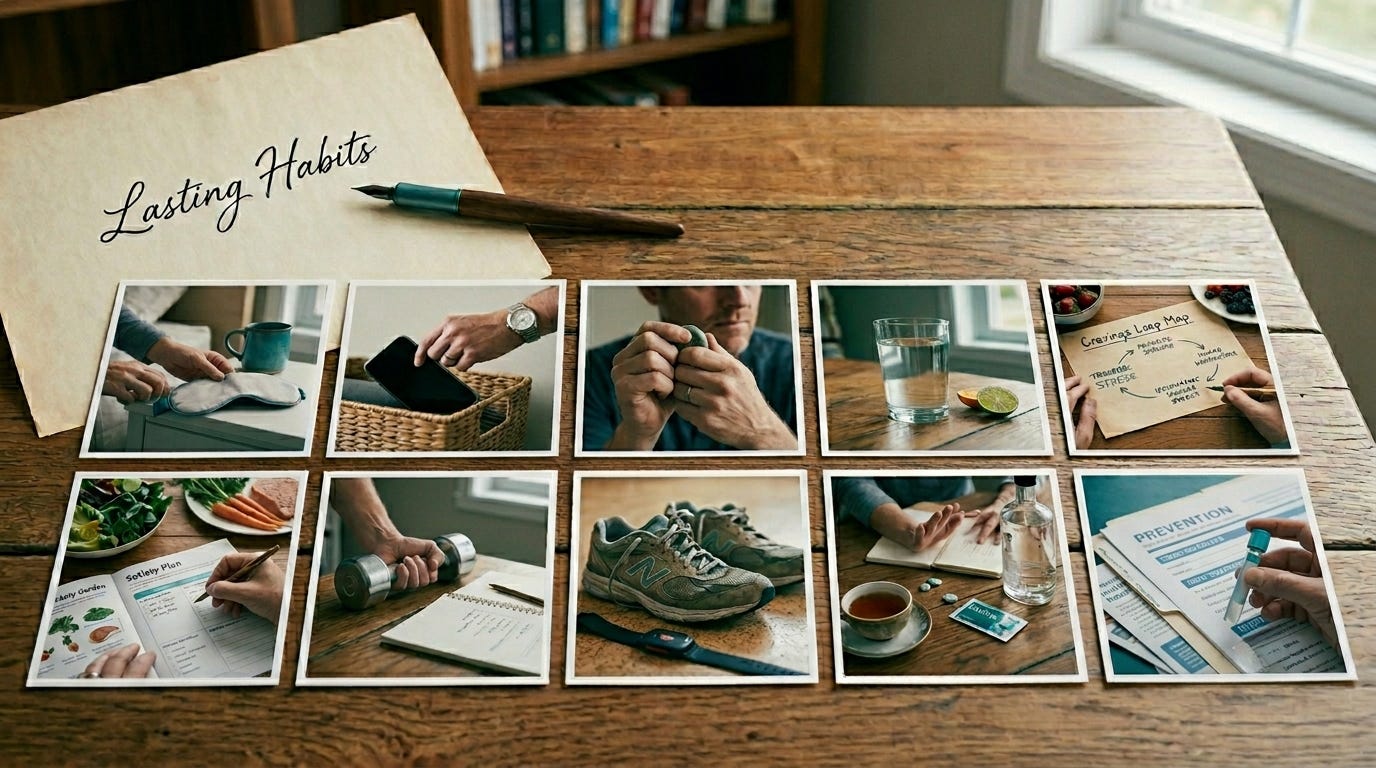
Welcome to the Lasting Habits Series
A once-a-week series of practical, doctor-designed health upgrades you can actually stick with.
Every Saturday, we’ll focus on one lever that makes everything else easier.
Here’s the roadmap:
Week 1 (sleep and recovery) explains how poor or fragmented sleep is often the real reason behind low mood, strong cravings, low energy, and feeling like you “lack willpower.” We covered why late nights and 3 a.m. wake-ups happen, how sleep regulates hunger, blood sugar, stress, and emotional resilience. The solution: a 7-day sleep reset plan, a step-by-step wind-down builder, troubleshooting guide for the most common patterns, and printable sleep reset toolkit.
Today’s post:
It provides you screen boundaries and a brain protection plan. It explains how constant screen use trains the brain to stay in urgency and interruption mode, draining focus, impulse control, sleep, and emotional regulation. We talked about how screens overstimulate the stress system, exhaust the brain’s self-control center, worsen cravings and nighttime restlessness, and undo the benefits of better sleep. The solution: a step-by-step screen boundaries builder, a 3-part “phone rules” system, a dopamine-friendly replacement list, a troubleshooting guide for the most common problems, and a printable screen boundaries brain protection plan.
Upcoming posts:
Week 3 is for people feeling wired, tired, and on edge. It explains why many people feel unable to relax even when nothing is “wrong”: their nervous system is stuck in a half-activated stress state from constant, low-grade demands. We talked about how chronic stress load builds up in the body, disrupting mood, sleep, cravings, and focus, and why this isn’t a willpower issue but a recovery problem. The solution: step-by-step stress resilience reset, a “turn off the alarm” strategy, the 3 most effective nervous system levers (and how to use them depending on your stress type), a stop-the-spiral protocol, and a printable nervous system reset plan you can keep visible—so you don’t have to remember what to do when you’re overwhelmed.
Week 4 covers how aging accelerates when you’re dehydrated (which is most common than people think). It explains how chronic, mild under-hydration can disrupt brain function, digestion, energy, and cravings—and may even be linked to accelerated aging over time. We talked about why thirst is an unreliable signal, how hydration hormones influence metabolic and cardiovascular stress, and why many “I feel off” symptoms improve when fluid intake is stabilized.
Week 5 breaks down why cravings aren’t a discipline failure but a predictable brain response to an ultra-processed food environment designed to keep you on autopilot. We talked about how portion distortion, misleading serving sizes, and hyper-reward foods hijack the brain’s reward system faster than true hunger signals can respond—especially when you’re stressed, tired, or distracted. The solution: a craving loop map to identify your main driver in minutes so you use the right fix instead of guessing (and failing), a troubleshooting guide for the most common patterns, and a printable 7-day autopilot breaker (small daily moves that retrain the default).
Week 6 shows how one simple habit has shaped human survival, from scurvy prevention in the 1700s to wartime “Victory Gardens.” You’ll discover about how fruits and vegetables stabilize appetite hormones, steady blood sugar, support gut–brain signaling, and are linked to lower risks of cardiovascular disease, cancer, depression, and early mortality. The solution: a personalized Mood and Satiety Plan designed around your goals, cravings, schedule, and real-life constraints. You answer targeted questions, and you receive a clear, practical plan that fits your day—so mood feels steadier and meals more satisfying without dieting.
Week 7 reframes strength as independence insurance, the habit that protects your ability to carry groceries, climb stairs, lift suitcases, and keep saying yes to normal life as you age. We’ll talk about how resistance training strengthens not just muscles but your nervous system, balance, mood stability, and long-term health. The solution: a step-by-step Lasting Strength Setup based on adherence strategies that showed promise in randomized controlled trials.
Week 8 shows that it’s never too late to rebuild your cardiovascular engine. Through the story of 92-year-old marathon finisher Mathea Allansmith, we talked about how cardio remains trainable at any age and why longevity depends more on consistency than intensity. The key idea: cardio helps you live longer, strength helps you live better—and the real challenge is building habits that survive real life. The solution: a practical Fitness Tracker that helps you define your starting point, set clear goals, track workouts, steps, body measurements, progress photos, and 30-day and 12-week challenges—so cardio and strength become a routine you can rely on.
Week 9 shows how repeated habits with alcohol and nicotine reshape your sleep, stress response, and reward system over time. Your brain learns the loop stress → substance → relief → repeat. Over time, that loop can destabilize mood, recovery, appetite, and long-term health. The solution: a simple 7-Day “Remove the Saboteurs” Experiment designed to reset your baseline. By testing small boundaries you interrupt the automatic cue-relief cycle and observe how sleep, mood, and cravings shift when your nervous system finally gets a steadier foundation.
In week 10 we talk about how prevention and early detection can dramatically change health outcomes, from removing precancerous polyps before cancer forms to reversing prediabetes and protecting brain, heart, and bone health long before damage becomes irreversible. The solution: knowing which preventive tests matter and monitoring key risk factors early. Combined with the daily habits from this series, these screenings give you the leverage to detect problems early, reverse risks sooner, and protect the decades ahead instead of reacting when disease finally shows symptoms.
If you’re done managing symptoms on repeat, you’re in the right place. This is the habit foundation most people never get.
Week 2: Screen Boundaries (Your Brain Protection Plan)
This is not a post about becoming anti-technology.
Screens aren’t evil.
But the way we use them is training our nervous system to live in a state of:
stimulation
urgency
interruption
comparison
and low-grade stress
And when your brain lives there…
Your habits don’t stand a chance.
Your Brain Is Stuck in “Interrupt Mode”
Here’s a normal day for most adults:
you wake up and check your phone “real quick”
your brain gets hit with other people’s problems, headlines, texts, emails
then you spend the day switching tasks, switching tabs, switching contexts
and at night, when you finally have quiet… your brain keeps scrolling anyway
And then of course you feel:
mentally tired but restless
easily overwhelmed
more irritable than usual
“tired but wired” at night
snacky for no reason
unfocused and behind
Your brain becomes what you repeatedly ask it to do.
And most of us are training it to be interrupted.
What Screens Do to Your Brain (the Medical Version Explained Like a Human)
Your brain has two important “teams” running your life:
1) The Smoke Alarm (Threat + Urgency)
This is the part that scans for danger and urgency.
It’s useful when something is actually on fire.
But screens feed it “micro-fires” all day: a scary headline, a tense email, a stressful reel, a comment section, a breaking news alert.
So your smoke alarm stays sensitive.
And when it’s sensitive, you feel:
jumpy
reactive
impatient
anxious “for no reason”
unable to relax even when you finally have time
2) The CEO Brain (Focus + Impulse Control)
This is the part that helps you:
make good decisions
resist impulses
follow through
stay calm under stress
But the CEO brain is energy-expensive.
It burns out fast when it’s constantly forced to:
switch tasks
resist temptation
ignore notifications
regulate emotions
make micro-decisions all day long
So by nighttime, the CEO is exhausted.
And when the CEO goes offline… your impulses take over.
That’s when you get:
“I’ll just scroll for a minute” → 47 minutes
“I’ll just snack a little” → suddenly it’s gone
“I’m too tired to work out”
“I’ll start tomorrow”
This is brain fatigue.
Why Screens Hit So Hard
Your brain has a built-in reward system designed to help you survive.
It pays extra attention to:
novelty (“what’s new?”)
social feedback (“did they reply?”)
potential danger (“what if I missed something?”)
uncertainty (“maybe the next scroll matters…”)
Modern apps are basically built on that blueprint.
Your phone is basically a slot machine with a glow screen:
Sometimes you scroll and nothing happens.
Sometimes you see something funny.
Sometimes someone likes your post.
Sometimes there’s drama.
Sometimes there’s an email you “should” respond to.
That unpredictability is what makes it so sticky.
Your brain learns: “Just one more… maybe there’s something important.”
So you keep swiping.
The Real Cost of Screens Isn’t What You Think
This is the part almost nobody talks about.
The biggest cost of screens isn’t the minutes you lose.
It’s what screens do to your ability to:
stay calm
focus
delay cravings
regulate stress
fall asleep and stay asleep
make good decisions when you’re tired
When you’re constantly stimulated, your baseline shifts.
You start needing more stimulation to feel normal.
And then feels uncomfortable.
So you reach for your phone again.
That’s why people say:
“I can’t focus anymore.”
“My brain feels foggy.”
“I’m always behind.”
“I can’t relax.”
“I don’t even enjoy TV anymore, I just scroll.”
That’s a brain that hasn’t had a real pause in years.
The Sleep Link (Why This Matters Right After Week 1)
Last week, we started with sleep because it’s the first domino.
This week is about the finger that keeps flicking it back over.
A 2024 meta-analysis of 55 studies (over 41,000 people) found that electronic media use is associated with worse sleep quality and more sleep problems, with stronger effects in problematic use patterns.¹
And in adults specifically, bedtime screen use keeps showing up as a repeat offender:
A 2025 study found that daily screen use before bed was associated with a higher prevalence of poor sleep quality, and slightly shorter sleep on workdays.²
What Happens When You Stop Scrolling
One of the clearest patterns in the research is this:
When people intentionally reduce social media use, their mental health often improves.
Digital “social media detox” interventions have been linked to a meaningful reduction in depressive symptoms when people intentionally cut back or take a break.3
At the same time, social media clearly isn’t all “bad.”
It can support connection, belonging, and emotional support.
But it also influences mental health, family functioning, and visual content exposure—showing real downsides too, like cyberbullying, constant comparison pressure, and stress effects, with especially strong relevance for women.4
And the bigger takeaway is this:
Digital technologies can have both positive and negative psychological effects in adults—meaning the real issue isn’t the existence of screens… it’s the dose, the timing, and the way you use them.5
The Real Goal: Screen Boundaries
This is where most people fail:
They try to use willpower against a device designed by teams of behavioral scientists.
Don’t do that. Build boundaries.
Every notification, every quick check, every “just one more scroll” is like a tiny knock on your door.
One knock is fine. But 100 knocks a day trains your body to stay alert—like something might happen any second.
Boundaries stop the knocking.
This week, we’re going to create a brain protection plan that works even if you’re busy and stressed.
A Quick Self-Check (Be Honest—No Shame)
Which one sounds most like you?
Phone-first mornings
You check your phone before your brain even wakes up.Constant micro-checking
You don’t scroll for an hour… you check 40 times for 30 seconds.Nighttime “revenge scrolling”
You scroll because the day didn’t feel like yours.Work + personal mixed all day
Email, Slack, texts, news, social… your brain never exits “work mode.”Your phone is your emotional regulator
Stress → phone. Bored → phone. Lonely → phone. Tired → phone.
If any of these are you, this post is for you.
The Three Most Powerful Boundaries (That Change Everything Fast)
Boundary #1: No-phone-first (the morning buffer)
Your brain is most impressionable in the first 30 minutes after waking.
If you start your day with urgency, comparison, and alerts… your nervous system learns: “Today is already a problem.”
Instead, build a buffer.
Try: no phone for the first 20 minutes after waking.
What you do instead:
10 slow breaths (long exhale)
drink water before coffee
sunlight (from Week 1)
2 minutes of stretching (neck + shoulders)
write 1 sentence: “Today will be a good day if ________________.”
Boundary #2: One-hour screen sunset (the night buffer)
If you want better sleep, cravings, and mood, this is the highest return.
Pick a time: 60 minutes before bed and treat it like a dimmer switch for your brain.
The rule:
No scrolling. No email. No news. No social.
You can still do something enjoyable:
reading
shower
skincare
gentle stretching
brain download (from Week 1)
The point is teaching your brain: “We are landing now.”
Boundary #3: Screens don’t eat with me (the appetite buffer)
When you eat while distracted, your brain misses satiety signals.
You can finish a whole meal and feel like you barely ate because your attention was somewhere else.
This matters for:
cravings
portion control
digestion
emotional eating
Try: one screen-free meal per day.
This is how you let your body notice: “I’m full.”
What You’ll Notice With Screen Boundaries
People usually report some version of:
less brain fog
less “background anxiety”
easier sleep onset
fewer 3 a.m. wake-ups
fewer cravings (especially at night)
more patience
more energy that feels stable, not wired
Not because you became a monk.
Because your nervous system finally gets a break.
This Week You’ll Discover
A step-by-step Screen Boundaries Builder (so you can design your plan around your real life).
The 3-part “Phone Rules” system: mornings, workday, evenings (with templates for busy parents and high-stress jobs).
A simple dopamine-friendly replacement list (what to do instead of scrolling that actually satisfies your brain).
A troubleshooting guide for the most common problems: “I need my phone for work,” “I scroll when I’m stressed,” and “I can’t stop at night.”
A Printable Screen Boundaries Brain Protection Plan you can keep on your desk or fridge—so in the moment you’re tempted to scroll, you don’t have to think… you just follow the plan.
Upgrade to unlock the complete guide below—and set your screen boundaries up once, so your brain can finally run on calm autopilot.
As always, every recommendation is based on the most solid and recent evidence.
