

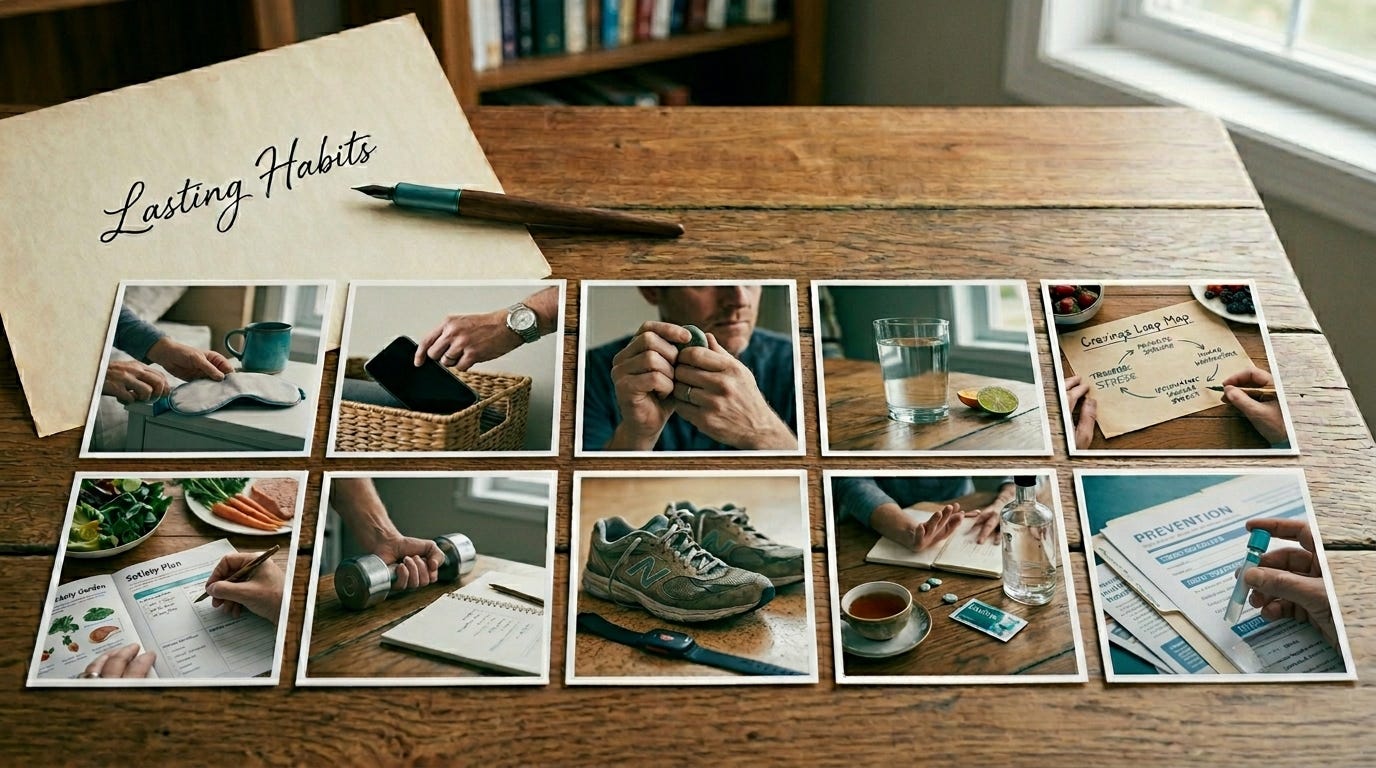
Welcome to the Lasting Habits Series
A once-a-week series of practical, doctor-designed health upgrades you can actually stick with.
Every Saturday, we’ll focus on one lever that makes everything else easier.
Here’s the roadmap:
Week 1 (sleep and recovery) explains how poor or fragmented sleep is often the real reason behind low mood, strong cravings, low energy, and feeling like you “lack willpower.” We covered why late nights and 3 a.m. wake-ups happen, how sleep regulates hunger, blood sugar, stress, and emotional resilience. The solution: a 7-day sleep reset plan, a step-by-step wind-down builder, troubleshooting guide for the most common patterns, and printable sleep reset toolkit.
Week 2 provides you screen boundaries and a brain protection plan. It explains how constant screen use trains the brain to stay in urgency and interruption mode, draining focus, impulse control, sleep, and emotional regulation. We talked about how screens overstimulate the stress system, exhaust the brain’s self-control center, worsen cravings and nighttime restlessness, and undo the benefits of better sleep. The solution: a step-by-step screen boundaries builder, a 3-part “phone rules” system, a dopamine-friendly replacement list, a troubleshooting guide for the most common problems, and a printable screen boundaries brain protection plan.
Week 3 is for people feeling wired, tired, and on edge. It explains why many people feel unable to relax even when nothing is “wrong”: their nervous system is stuck in a half-activated stress state from constant, low-grade demands. We talked about how chronic stress load builds up in the body, disrupting mood, sleep, cravings, and focus, and why this isn’t a willpower issue but a recovery problem. The solution: step-by-step stress resilience reset, a “turn off the alarm” strategy, the 3 most effective nervous system levers (and how to use them depending on your stress type), a stop-the-spiral protocol, and a printable nervous system reset plan you can keep visible—so you don’t have to remember what to do when you’re overwhelmed.
Week 4 covers how aging accelerates when you’re dehydrated (which is most common than people think). It explains how chronic, mild under-hydration can disrupt brain function, digestion, energy, and cravings—and may even be linked to accelerated aging over time. We talked about why thirst is an unreliable signal, how hydration hormones influence metabolic and cardiovascular stress, and why many “I feel off” symptoms improve when fluid intake is stabilized.
Week 5 breaks down why cravings aren’t a discipline failure but a predictable brain response to an ultra-processed food environment designed to keep you on autopilot. We talked about how portion distortion, misleading serving sizes, and hyper-reward foods hijack the brain’s reward system faster than true hunger signals can respond—especially when you’re stressed, tired, or distracted. The solution: a craving loop map to identify your main driver in minutes so you use the right fix instead of guessing (and failing), a troubleshooting guide for the most common patterns, and a printable 7-day autopilot breaker (small daily moves that retrain the default).
Week 6 shows how one simple habit has shaped human survival, from scurvy prevention in the 1700s to wartime “Victory Gardens.” You’ll discover about how fruits and vegetables stabilize appetite hormones, steady blood sugar, support gut–brain signaling, and are linked to lower risks of cardiovascular disease, cancer, depression, and early mortality. The solution: a personalized Mood and Satiety Plan designed around your goals, cravings, schedule, and real-life constraints. You answer targeted questions, and you receive a clear, practical plan that fits your day—so mood feels steadier and meals more satisfying without dieting.
Today’s post reframes strength as independence insurance, the habit that protects your ability to carry groceries, climb stairs, lift suitcases, and keep saying yes to normal life as you age. We’ll talk about how resistance training strengthens not just muscles but your nervous system, balance, mood stability, and long-term health. The solution: a step-by-step Lasting Strength Setup based on adherence strategies that showed promise in randomized controlled trials.
Upcoming posts:
Week 8 shows that it’s never too late to rebuild your cardiovascular engine. Through the story of 92-year-old marathon finisher Mathea Allansmith, we talked about how cardio remains trainable at any age and why longevity depends more on consistency than intensity. The key idea: cardio helps you live longer, strength helps you live better—and the real challenge is building habits that survive real life. The solution: a practical Fitness Tracker that helps you define your starting point, set clear goals, track workouts, steps, body measurements, progress photos, and 30-day and 12-week challenges—so cardio and strength become a routine you can rely on.
Week 9 shows how repeated habits with alcohol and nicotine reshape your sleep, stress response, and reward system over time. Your brain learns the loop stress → substance → relief → repeat. Over time, that loop can destabilize mood, recovery, appetite, and long-term health. The solution: a simple 7-Day “Remove the Saboteurs” Experiment designed to reset your baseline. By testing small boundaries you interrupt the automatic cue-relief cycle and observe how sleep, mood, and cravings shift when your nervous system finally gets a steadier foundation.
In week 10 we talk about how prevention and early detection can dramatically change health outcomes, from removing precancerous polyps before cancer forms to reversing prediabetes and protecting brain, heart, and bone health long before damage becomes irreversible. The solution: knowing which preventive tests matter and monitoring key risk factors early. Combined with the daily habits from this series, these screenings give you the leverage to detect problems early, reverse risks sooner, and protect the decades ahead instead of reacting when disease finally shows symptoms.
If you’re done managing symptoms on repeat, you’re in the right place. This is the habit foundation most people never get.
Week 7: Strength (Your Independence Insurance)
A few years ago, one of my patients told me something that changed the way I explain exercise forever.
She said something like: “I just care about not becoming a burden. I don’t want to stop carrying groceries in one trip, or start avoiding stairs. I want to be able to carry my grandchildren, I want to lift a suitcase without asking for help, and I want to keep saying yes to normal life without needing a recovery day.”
That’s independence, and strength is the closest thing we have to an insurance policy for that.
Strength Isn’t Only Muscle
The first thing that improves when you train is often your nervous system.
Your brain gets better at:
Recruiting muscle fibers
Coordinating movement
Turning on the right muscles at the right time
That’s one reason beginners can get stronger fast.
This matters because coordination is what prevents the classic aging cascade:
a small misstep → loss of balance → injury → fear → less movement → more weakness
Strength training helps you interrupt that story early.
And for older adults with sarcopenia (age-related muscle loss), a 2026 systematic review and meta-analysis of randomized trials found resistance training significantly improved muscle strength, lean mass, walking ability, and grip strength.¹
Wait… Grip Strength?
Yes, this may surprise you, but the simple act of how hard you can squeeze your hand is one of the most powerful predictors of future health, disability, and even cognitive decline.2
It serves as an excellent proxy for your overall body strength. A firm handshake is a sign of a body that is still robust and capable.
The Benefit Nobody Talks About: Mood + Calm
We should put strength in the “body” category AND the “mental health” category.
In a UK Biobank prospective cohort study, people with higher handgrip strength had a lower incidence of depression and anxiety over time.3
Translation: when you’re building strength, you’re also training your mood to be less reactive.
Why Most People “Fail” at Strength
This series is about building habits that still happen when life is messy. Most adults fail because the plan they tried required a version of them that only exists on calm, motivated weeks.
Strength training is the perfect example. People quit because the program collides with reality:
They miss a week and feel like they “ruined it”
The workouts feel too hard (or too boring)
They don’t know how to progress
They don’t see results fast enough
They get sore, busy, or stressed, and the habit disappears
That’s why we should ask ourselves:
How do we build strength habits that survive real life?
The Adherence Solution
A recent analysis of randomized controlled trials looked specifically at what improves resistance training adherence—meaning: what gets people to keep showing up.
And it found what clinicians and coaches see every day: dropout is common, but certain strategies reliably improve adherence because they increase enjoyment, confidence, and perceived support.4
In lasting habits, adherence is everything.
A plan that is “simple” but you can repeat for years is life-changing.
So here’s what the evidence suggests actually moves the needle.
What Actually Helps People Stick With Strength Training (and Why It Works)
1) Variety (so your brain doesn’t label training as a chore)
The study found that increasing exercise variety, especially paired with support, can improve adherence.
Your brain constantly predicts: “Is this worth doing again?”
If training is monotonous, your brain starts assigning it a lower “value,” even if you logically know it’s good.
Variety does two powerful things:
It reduces boredom (which is a major dropout trigger)
It increases perceived competence because you feel like you’re learning and improving—not just suffering through repeats
In this series, we’ve repeated a key idea: you repeat what feels doable and rewarding.
Strength needs to feel like that too.
2) Support (so the habit doesn’t depend on motivation)
The study highlighted high perceived social or professional support as a strategy linked with better adherence.
Support works because it reduces the mental load. It turns training from “a decision you must make daily” into “a default you follow.”
When you’re already carrying work, family, stress, and screens, your brain will pick the easiest option at the end of the day. Support makes the healthy choice easier to execute.
3) Smart structure (so it feels manageable, not brutal)
One of the strategies mentioned was using cluster sets.
Instead of one long hard set, you break it into smaller chunks with tiny rests.
Cluster sets can reduce that “I’m dying” sensation, improve form, and make sessions feel more achievable, especially for beginners or busy people who associate exercise with feeling wrecked.
A lasting habit should leave you thinking: “That was doable, and I want to do it again.”
4) Flexible programming (so life doesn’t break the plan)
The study also noted non-linear periodization as a promising adherence strategy.
In plain English: the plan has built-in flexibility—some days lighter, some days heavier—rather than forcing the same intensity every single week.
Your recovery capacity changes with sleep quality, stress load, travel, illness, menstrual cycle shifts, workload spikes…
If your plan is rigid, you’ll “fail” every time your body is not at 100%. A plan with flexibility protects the habit, because it teaches you you can train even when circumstances are not perfect.
That’s the entire philosophy of this series.
5) Behavioral tools (so you can see progress and stay in the game)
The study found that strategies like self-monitoring, feedback, and goal setting can improve adherence.
Your brain needs evidence that something is working, soon enough to keep going.
This is how you turn training into a reinforcing loop instead of a random act of effort.
What You’ll Get this Week
This week, you’ll unlock a step-by-step Lasting Strength Setup based on adherence strategies that showed promise in randomized controlled trials: the right dose of variety, built-in support, doable set structure, non-linear progression, and simple tracking.
