

January does this thing to us.
It makes your brain whisper, “This is it. This is the year.”
Like the new calendar is a fresh start.
So we aim high: new habits, more discipline or bigger goals.
But if you’ve tried before, you already know: motivation is loud in week one… and quiet a few weeks later.
And then you start thinking you need “more willpower.”
No. You do not.
The healthiest, happiest people count on doing little things over and over, so it just becomes automatic. They build habits that still happen on the hard days.
Especially on the hard days.
So this year, forget about finding endless motivation.
Let’s build the foundation the medical system rarely has time to teach. We’re not going to outsource your health to prescriptions and panic.
Let’s do it the right way.
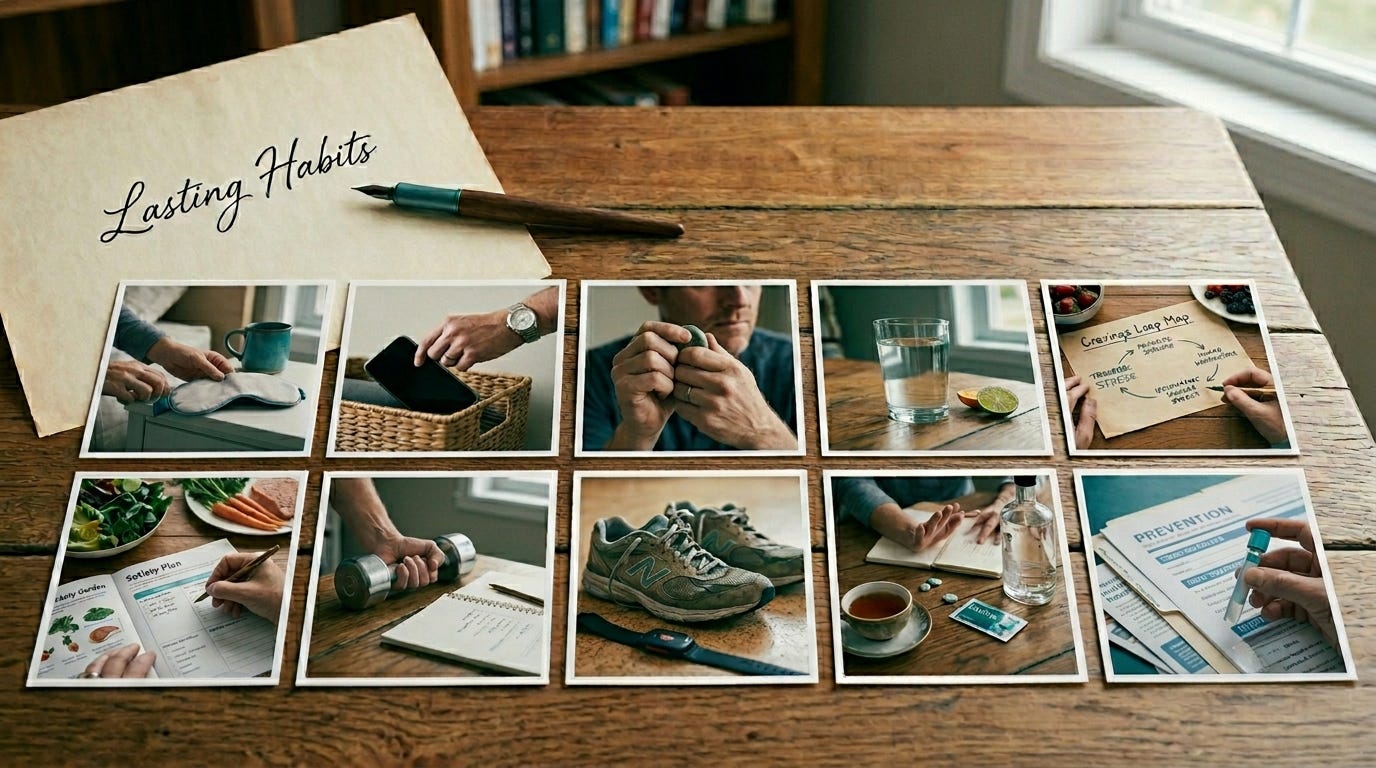
Welcome to the Lasting Habits Series
A once-a-week series of practical, doctor-designed health upgrades you can actually stick with.
Every Saturday, we’ll focus on one lever that makes everything else easier.
Here’s the roadmap:
Today’s post:
It explains how poor or fragmented sleep is often the real reason behind low mood, strong cravings, low energy, and feeling like you “lack willpower.” We covered why late nights and 3 a.m. wake-ups happen, how sleep regulates hunger, blood sugar, stress, and emotional resilience. The solution: a 7-day sleep reset plan, a step-by-step wind-down builder, troubleshooting guide for the most common patterns, and printable sleep reset toolkit.
Upcoming posts:
Week 2 provides you screen boundaries and a brain protection plan. It explains how constant screen use trains the brain to stay in urgency and interruption mode, draining focus, impulse control, sleep, and emotional regulation. We talked about how screens overstimulate the stress system, exhaust the brain’s self-control center, worsen cravings and nighttime restlessness, and undo the benefits of better sleep. The solution: a step-by-step screen boundaries builder, a 3-part “phone rules” system, a dopamine-friendly replacement list, a troubleshooting guide for the most common problems, and a printable screen boundaries brain protection plan.
Week 3 is for people feeling wired, tired, and on edge. It explains why many people feel unable to relax even when nothing is “wrong”: their nervous system is stuck in a half-activated stress state from constant, low-grade demands. We talked about how chronic stress load builds up in the body, disrupting mood, sleep, cravings, and focus, and why this isn’t a willpower issue but a recovery problem. The solution: step-by-step stress resilience reset, a “turn off the alarm” strategy, the 3 most effective nervous system levers (and how to use them depending on your stress type), a stop-the-spiral protocol, and a printable nervous system reset plan you can keep visible—so you don’t have to remember what to do when you’re overwhelmed.
Week 4 covers how aging accelerates when you’re dehydrated (which is most common than people think). It explains how chronic, mild under-hydration can disrupt brain function, digestion, energy, and cravings—and may even be linked to accelerated aging over time. We talked about why thirst is an unreliable signal, how hydration hormones influence metabolic and cardiovascular stress, and why many “I feel off” symptoms improve when fluid intake is stabilized.
Week 5 breaks down why cravings aren’t a discipline failure but a predictable brain response to an ultra-processed food environment designed to keep you on autopilot. We talked about how portion distortion, misleading serving sizes, and hyper-reward foods hijack the brain’s reward system faster than true hunger signals can respond—especially when you’re stressed, tired, or distracted. The solution: a craving loop map to identify your main driver in minutes so you use the right fix instead of guessing (and failing), a troubleshooting guide for the most common patterns, and a printable 7-day autopilot breaker (small daily moves that retrain the default).
Week 6 shows how one simple habit has shaped human survival, from scurvy prevention in the 1700s to wartime “Victory Gardens.” You’ll discover about how fruits and vegetables stabilize appetite hormones, steady blood sugar, support gut–brain signaling, and are linked to lower risks of cardiovascular disease, cancer, depression, and early mortality. The solution: a personalized Mood and Satiety Plan designed around your goals, cravings, schedule, and real-life constraints. You answer targeted questions, and you receive a clear, practical plan that fits your day—so mood feels steadier and meals more satisfying without dieting.
Week 7 reframes strength as independence insurance, the habit that protects your ability to carry groceries, climb stairs, lift suitcases, and keep saying yes to normal life as you age. We’ll talk about how resistance training strengthens not just muscles but your nervous system, balance, mood stability, and long-term health. The solution: a step-by-step Lasting Strength Setup based on adherence strategies that showed promise in randomized controlled trials.
Week 8 shows that it’s never too late to rebuild your cardiovascular engine. Through the story of 92-year-old marathon finisher Mathea Allansmith, we talked about how cardio remains trainable at any age and why longevity depends more on consistency than intensity. The key idea: cardio helps you live longer, strength helps you live better—and the real challenge is building habits that survive real life. The solution: a practical Fitness Tracker that helps you define your starting point, set clear goals, track workouts, steps, body measurements, progress photos, and 30-day and 12-week challenges—so cardio and strength become a routine you can rely on.
Week 9 shows how repeated habits with alcohol and nicotine reshape your sleep, stress response, and reward system over time. Your brain learns the loop stress → substance → relief → repeat. Over time, that loop can destabilize mood, recovery, appetite, and long-term health. The solution: a simple 7-Day “Remove the Saboteurs” Experiment designed to reset your baseline. By testing small boundaries you interrupt the automatic cue-relief cycle and observe how sleep, mood, and cravings shift when your nervous system finally gets a steadier foundation.
In week 10 we talk about how prevention and early detection can dramatically change health outcomes, from removing precancerous polyps before cancer forms to reversing prediabetes and protecting brain, heart, and bone health long before damage becomes irreversible. The solution: knowing which preventive tests matter and monitoring key risk factors early. Combined with the daily habits from this series, these screenings give you the leverage to detect problems early, reverse risks sooner, and protect the decades ahead instead of reacting when disease finally shows symptoms.
If you’re done managing symptoms on repeat, you’re in the right place. This is the habit foundation most people never get.
How Sleep Became the First Domino
It always starts innocently.
A little Netflix. One more email. One more “quick scroll.” One more episode because the day finally feels like yours.
And then it’s 12:13 a.m.
You climb into bed, exhausted… and your mind switches on like a stadium.
Tomorrow’s to-do list. That awkward conversation. The thing you forgot. The thing you should’ve done differently.
You finally fall asleep—only to wake up at 3:06 a.m., wide awake, heart slightly faster than it should be, brain running background tabs you never opened on purpose.
Morning comes. You drag yourself up. Coffee becomes a life raft. Sugar feels tempting. Your patience is thinner. Your cravings are louder. Your workouts feel harder. Your mood is more fragile.
And the worst part is that you start blaming yourself.
“I’m not disciplined.”
“I’m lazy.”
“I have no willpower.”
“I can’t stick to healthy habits.”
And suddenly it’s not the plan that failed, it’s you.
But I want you to consider this:
What if your “willpower problem” is actually a sleep problem?
Week 1: The Habit That Controls Your Mood, Weight, and Lifespan
I can’t count how many times I’ve seen this exact pattern:
Someone comes for weight struggles, anxiety, low mood, fatigue, cravings, blood sugar swings, and sometimes all of them.
They’re convinced the solution has to be something like a perfect diet or a fancy supplement.
But when we zoom out, one thing shows up like a fingerprint:
Sleep is inconsistent, fragmented, late, or low-quality.
Lack of sleep affects our mood1 and is linked to a higher risk of obesity2 and mortality from cardiovascular diseases3.
When sleep is off, everything downstream becomes harder:
appetite signals get louder and less accurate
stress tolerance drops
motivation becomes unreliable
recovery slows
emotional resilience thins out
Think of it like your phone.
You can keep tapping and swiping on 3% battery… but everything glitches: it freezes, overheats, apps crash, and you start making weird choices (“I’ll just order something fast” becomes “family-size chips + cookies at midnight”).
Sleep is your nightly recharge + software update.
Skip it, and your body runs on a laggy operating system.
Your Body Has Two Modes (and Sleep Is the Switch)
Your nervous system is basically a car with two pedals:
Gas pedal = alertness, urgency, “go mode” (stress hormones, adrenaline, cortisol)
Brake pedal = calm, repair, digestion, recovery (“rest-and-digest” mode)
Modern life keeps our foot on the gas all day.
Then we expect sleep to happen instantly, like flipping a switch.
But sleep is more like landing a plane, you need a descent to go from full speed to touchdown.
That’s why you might “go to bed” but don’t actually downshift.
You bring the whole day into the pillow.
Why You Wake Up at 3 A.M.
That 3:06 a.m. wake-up is so common it deserves its own explanation.
In the second half of the night, your body naturally starts to:
lighten sleep a bit
ramp up cortisol gradually (so you can wake up later)
process memories and emotions
If you’re under stress, sleeping too hot, drinking alcohol, eating late, or your sleep schedule is inconsistent, that normal shift can turn into: eyes open, mind racing, heart slightly faster than it should be.
It’s like your body checks the room and says: “Are we safe enough to keep sleeping?”
If the answer is “I’m not sure,” your brain starts scanning: finances, relationships, emails, tomorrow, everything.
Sleep Is Metabolic Control
Here’s what sleep is doing behind the scenes (in plain English):
1) Sleep tunes your hunger hormones
When sleep is short or fragmented, your appetite signals get distorted:
Ghrelin (hunger) tends to rise
Leptin (satiety) tends to fall
Translation: you feel hungrier and less satisfied, even if you ate enough.
2) Sleep stabilizes blood sugar
Even a few nights of poor sleep can reduce insulin sensitivity.
Translation: your body needs more insulin to handle the same carbs → more cravings, energy crashes, and “hangry” moments.
3) Sleep is emotional shock absorption
With poor sleep, the brain’s threat detector gets jumpier, and your rational “brakes” don’t work as well.
Translation: you’re more reactive, more anxious, more sensitive, and it takes less to push you over the edge.
4) Sleep is repair time
During deep sleep, the body prioritizes tissue repair, immune function, and recovery.
Translation: your workouts feel harder and you recover slower when sleep is off.
5) Sleep is brain cleanup
At night, the brain runs a “cleaning cycle” (the glymphatic system) that helps clear metabolic waste.
Translation: your brain needs sleep to feel sharp, steady, and emotionally balanced.
So yes—sleep affects mood and weight.
But it also affects blood pressure, inflammation, immune resilience, and long-term overall health.
The Real Goal Is NOT More Time in Bed
Most people try to fix sleep by forcing bedtime:
Earlier bedtime. More time in bed. New pillow. New supplement.
But what works best is this:
Anchor your wake time and build a routine your body keeps comfortable with everyday.
Your sleep-wake cycle is driven by timing cues:
light exposure (especially morning light)
meal timing
caffeine timing
movement
temperature
stress downshifts
consistency
When those cues align, your body starts doing what it was designed to do:
fall asleep easier, stay asleep longer, and wake up clearer.
The 30–60–90 Runway (Your “Landing a Plane” Routine)
As we were saying, most people just need a downshift sequence.
90 minutes before bed: “Dim and disconnect”
lower overhead lights
stop working if possible
avoid emotionally activating content (doomscrolling counts)
60 minutes before bed: “Warm + slow”
Pick one:
a warm shower
gentle stretching
reading something calm
a simple skincare routine (yes, this counts as a signal)
Why warm? Because afterward your body cools down, and a drop in core temperature helps sleep onset.
30 minutes before bed: “Brain download”
This is a medical doctor favorite because it works.
Write:
3 things you’re worried about
1 next step for each (tiny is fine)
3 things you did today that count as a win
You’re telling your brain:
“We captured it. You don’t have to rehearse it at 3 a.m.”
The 3 A.M. Protocol (What to Do When You Wake Up)
First: don’t panic.
Waking briefly is normal. The problem is the story we attach to it (“I’m ruined tomorrow”).
Try this sequence:
No clock-checking (it trains alertness).
Keep lights low.
Do a body cue, not a mind cue:
slow breathing: inhale 4, exhale 6 (or any longer exhale)
progressive muscle relaxation
If you’re awake >20–30 minutes, get out of bed and do something boring and dim (read paper book, sit quietly). Return when sleepy.
This protects the bed as a “sleep-only” association.
And if you wake up with a racing heart:
That’s often a sympathetic spike. Longer exhales help nudge the brake pedal.
The Sleep Killers Most People Don’t Connect
Caffeine timing
Caffeine has a long half-life. For many adults, no caffeine after 12–2 p.m. is the difference between “I sleep” and “I’m tired but wired.”
Alcohol
Alcohol can make you sleepy at first—then fragments sleep later and worsens 3 a.m. wake-ups.
Weekend “sleeping in”
It feels like catch-up, but it can shift your internal clock later (like mini jet lag every Monday).
Late meals
Eating close to bedtime keeps digestion active and can raise body temperature.

Why Sleep Matters More Than People Think
Sleep is where your body:
recalibrates appetite and cravings
consolidates memory and learning
regulates stress hormones
repairs tissues
resets emotional reactivity
stabilizes blood sugar
supports immune function
That’s why sleep is one of the highest-leverage habits on earth.
And yet, our medical system often skip the root and jump straight to the prescription pad: something for anxiety, something for mood, something for cravings, something for blood sugar...
And then another one to deal with the side effects.
But if you start the year with a habit that makes every other habit simpler…
That’s how transformation finally sticks.
Week 1: The Sleep Reset
Today, we’re starting with the first domino.
With a feel-good, repeatable sleep reset that works even if you have kids, a job, a busy brain, or a messy schedule.
Here’s what I want you to take with you today:
If your sleep is unstable, your cravings and mood will feel unstable too.
And if you stabilize your sleep rhythm, you’ll be shocked how many things get easier.
This Week You’ll Discover
A 7-day Sleep Reset plan designed to stabilize your rhythm quickly—without prescriptions or complicated tracking.
A step-by-step Wind-Down Builder that helps you create a pre-sleep routine that calms your nervous system (even if you don’t meditate).
A simple troubleshooting guide for the most common patterns: trouble falling asleep, waking at 3 a.m., and waking up tired.
A printable Sleep Reset Toolkit you can keep on your nightstand and use like a checklist.
Upgrade to unlock the complete guide below—and set your sleep schedule up once, so it starts running on autopilot for the rest of the year.
As always, every recommendation is based on the most solid and recent evidence.
