

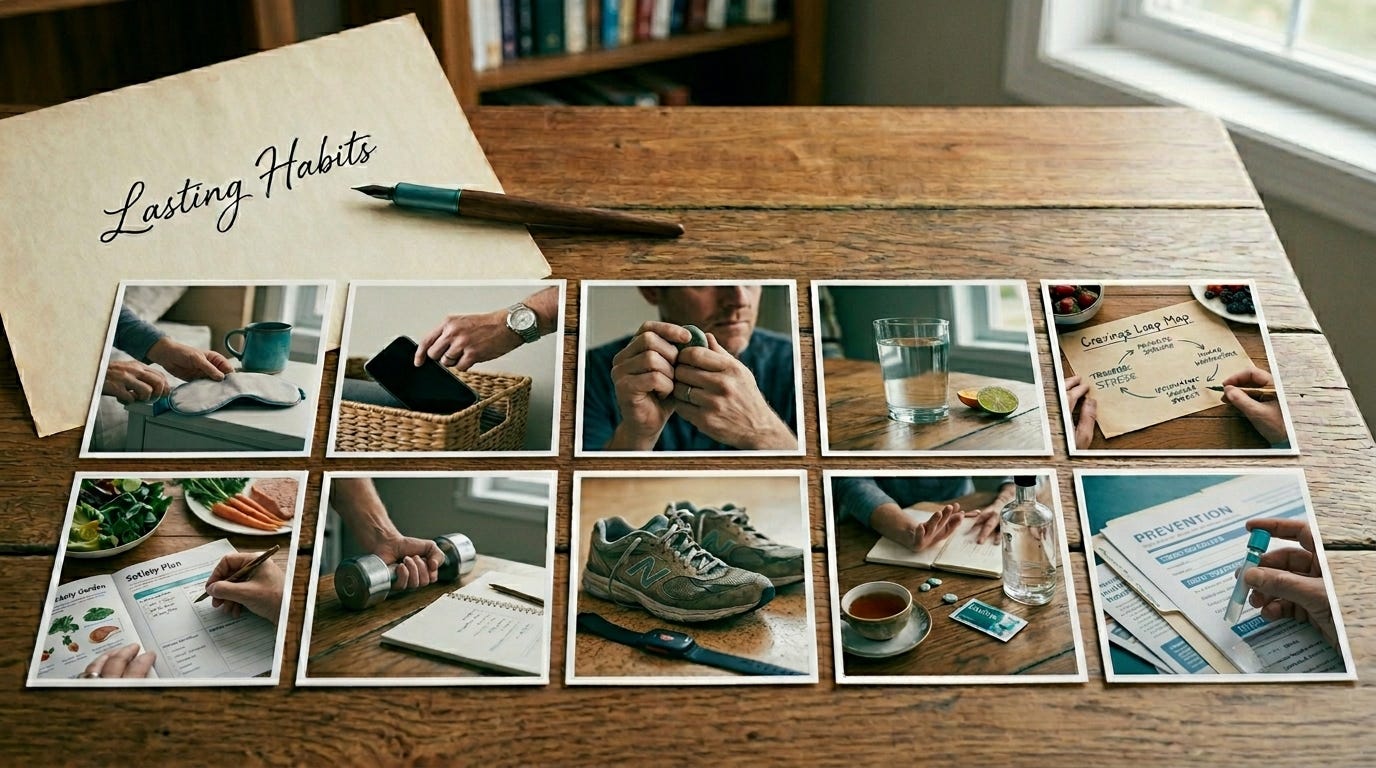
Welcome to the Lasting Habits Series
A once-a-week series of practical, doctor-designed health upgrades you can actually stick with.
Every Saturday, we’ll focus on one lever that makes everything else easier.
Here’s the roadmap:
Week 1 (sleep and recovery) explains how poor or fragmented sleep is often the real reason behind low mood, strong cravings, low energy, and feeling like you “lack willpower.” We covered why late nights and 3 a.m. wake-ups happen, how sleep regulates hunger, blood sugar, stress, and emotional resilience. The solution: a 7-day sleep reset plan, a step-by-step wind-down builder, troubleshooting guide for the most common patterns, and printable sleep reset toolkit.
Week 2 provides you screen boundaries and a brain protection plan. It explains how constant screen use trains the brain to stay in urgency and interruption mode, draining focus, impulse control, sleep, and emotional regulation. We talked about how screens overstimulate the stress system, exhaust the brain’s self-control center, worsen cravings and nighttime restlessness, and undo the benefits of better sleep. The solution: a step-by-step screen boundaries builder, a 3-part “phone rules” system, a dopamine-friendly replacement list, a troubleshooting guide for the most common problems, and a printable screen boundaries brain protection plan.
Week 3 is for people feeling wired, tired, and on edge. It explains why many people feel unable to relax even when nothing is “wrong”: their nervous system is stuck in a half-activated stress state from constant, low-grade demands. We talked about how chronic stress load builds up in the body, disrupting mood, sleep, cravings, and focus, and why this isn’t a willpower issue but a recovery problem. The solution: step-by-step stress resilience reset, a “turn off the alarm” strategy, the 3 most effective nervous system levers (and how to use them depending on your stress type), a stop-the-spiral protocol, and a printable nervous system reset plan you can keep visible—so you don’t have to remember what to do when you’re overwhelmed.
Week 4 covers how aging accelerates when you’re dehydrated (which is most common than people think). It explains how chronic, mild under-hydration can disrupt brain function, digestion, energy, and cravings—and may even be linked to accelerated aging over time. We talked about why thirst is an unreliable signal, how hydration hormones influence metabolic and cardiovascular stress, and why many “I feel off” symptoms improve when fluid intake is stabilized.
Week 5 breaks down why cravings aren’t a discipline failure but a predictable brain response to an ultra-processed food environment designed to keep you on autopilot. We talked about how portion distortion, misleading serving sizes, and hyper-reward foods hijack the brain’s reward system faster than true hunger signals can respond—especially when you’re stressed, tired, or distracted. The solution: a craving loop map to identify your main driver in minutes so you use the right fix instead of guessing (and failing), a troubleshooting guide for the most common patterns, and a printable 7-day autopilot breaker (small daily moves that retrain the default).
Week 6 shows how one simple habit has shaped human survival, from scurvy prevention in the 1700s to wartime “Victory Gardens.” You’ll discover about how fruits and vegetables stabilize appetite hormones, steady blood sugar, support gut–brain signaling, and are linked to lower risks of cardiovascular disease, cancer, depression, and early mortality. The solution: a personalized Mood and Satiety Plan designed around your goals, cravings, schedule, and real-life constraints. You answer targeted questions, and you receive a clear, practical plan that fits your day—so mood feels steadier and meals more satisfying without dieting.
Week 7 reframes strength as independence insurance, the habit that protects your ability to carry groceries, climb stairs, lift suitcases, and keep saying yes to normal life as you age. We’ll talk about how resistance training strengthens not just muscles but your nervous system, balance, mood stability, and long-term health. The solution: a step-by-step Lasting Strength Setup based on adherence strategies that showed promise in randomized controlled trials.
Today’s post: surprise surprise!
Upcoming posts:
Week 9 shows how repeated habits with alcohol and nicotine reshape your sleep, stress response, and reward system over time. Your brain learns the loop stress → substance → relief → repeat. Over time, that loop can destabilize mood, recovery, appetite, and long-term health. The solution: a simple 7-Day “Remove the Saboteurs” Experiment designed to reset your baseline. By testing small boundaries you interrupt the automatic cue-relief cycle and observe how sleep, mood, and cravings shift when your nervous system finally gets a steadier foundation.
In week 10 we talk about how prevention and early detection can dramatically change health outcomes, from removing precancerous polyps before cancer forms to reversing prediabetes and protecting brain, heart, and bone health long before damage becomes irreversible. The solution: knowing which preventive tests matter and monitoring key risk factors early. Combined with the daily habits from this series, these screenings give you the leverage to detect problems early, reverse risks sooner, and protect the decades ahead instead of reacting when disease finally shows symptoms.
If you’re done managing symptoms on repeat, you’re in the right place. This is the habit foundation most people never get.
Week 8: 92-Year-Old Marathon Proof—Your Comeback Starts Now
On December 11, 2022, the sun came up over Honolulu and thousands of people did what runners always do before a big race: they adjusted shoelaces, checked their watches, made small talk to calm their nerves, and tried not to think too far ahead.
In the middle of that crowd was Mathea Allansmith.
She was there for the same reason most people are there: to see what her body could still do, and to keep a promise to herself about staying alive inside her life.
Mathea was 92 years old.
And that morning, she completed a full marathon—42.195 km / 26.2 miles—at the 2022 Honolulu Marathon. Her finish time was 11:19:49, and it was officially verified as the oldest woman to complete a marathon.

I’m not telling you this because I think you need to run a marathon.
Her story dissolves one of the most damaging beliefs people carry quietly for years:
“It’s too late for me.”
It is NOT.
Cardio is a trainable engine, and the most important thing about an engine isn’t how hard you rev it once. It’s whether you keep it running, gently and consistently, long enough for your body to adapt.
That’s what this week is about: cardio you can stick with—the kind that survives busy weeks, bad sleep, stress, travel, and real life.
Cardio Vs. Strength: The Endless Debate
Broccoli or apple? Why should we choose? The debate is similar.
Both have been extensively researched and backed by solid evidence worldwide.
I just want you to remember this simple message in your head, forever:
Cardio gives you more years of life
Strength gives you quality to those years
We’ve already talked about this before:


But in this series, we’re focusing on making healthy habits last.
How to Make Cardio Stick and Enjoyable
When a habit fails repeatedly, it’s frequently because the design demanded too much on the days you were tired, busy, stressed, or off-schedule.
A lasting cardio habit sticks when it has five features:
1) Low start-cost
If cardio requires perfect weather, a full hour, special equipment, or a commute, it won’t survive your busiest week.
A lasting plan starts with low friction: shoes by the door, a consistent time window, a default you can do anywhere, and a rule that 10 minutes counts.
2) Feedback (so your brain believes it’s working)
Your brain repeats what it can see.
This is why step counts and wearables can help adherence: they turn a vague goal (“be more active”) into a visible signal (“I did it today”).
In healthy adults, a systematic review and meta-analysis of randomized controlled trials found wearable trackers produced modest improvements in physical activity versus control conditions.¹
I tested this on myself, and it works. I signed up for a bank account that literally rewards you for the number of steps you take each day. At first, it felt amazing: a little “bribe” for being healthier. After a while, I caught myself doing the same walking routine even when I wasn’t wearing my tracker. My brain had already learned to associate walking with a reward, even without the small gadget.
And in children and adolescents (relevant for many parents), a 2024 systematic review and meta-analysis found wearables might increase daily steps, even if effects on moderate-to-vigorous activity are less consistent.²
Translation: the wearable isn’t the magic. Feedback is.
3) Behavior tools that stick (self-monitoring, goals, feedback)
Wearables work best when they’re paired with simple behavior-change “glue”: a goal, a plan, and a way to see progress.
An umbrella review of interventions promoting physical activity in adults with chronic conditions found that techniques like self-monitoring, feedback, and goal setting are commonly associated with better activity outcomes.³
You’ll have this covered at the end of the post.
4) Support (social or professional)
Cardio sticks when someone (or something) helps you show up.
That’s why, in cardiac rehabilitation (where adherence is literally life-protective), many programs now offer home-based options and remote check-ins. Lower friction means higher participation. When you don’t have to drive somewhere, find parking, rearrange childcare, or block a full hour, more people actually follow through.⁴
You can use the same principle without a formal program:
Social support: pick one person and send a “done” text after your sessions.
Professional support: one trainer session per month or a structured class you commit to weekly.
Tech support: set a step goal and let your watch/phone nudge you (a tiny external push that reduces decision fatigue).
The right support helps you treat your habit like a non-negotiable.
5) Flexibility (avoid all-or-nothing mindset)
Okay, here I must confess I’m working on it, I know… it’s not easy.
I’m the type of person who ends up thinking (even though I know it’s not true):
“I missed Tuesday, so the week is ruined.”
Flexible plans survive because they have a prewritten recovery rule:
“If I miss, I do the 10-minute version next.”
That one rule is the difference between “a habit” and “a phase.”
It’s about finding the “trick” that works for you.
Fitness Tracker
As this series is about lasting habits, I want to help you, once again, to achieve that goal. This time, combining cardio and strength from last week (remember we want both!)
So below, you’ll find a practical fitness tracker which:
Turns vague goals into a clear plan (and keeps you emotionally invested). The “This is me” page helps you define your starting point (height, weight, start/goal/date), your why (3 motivations), and the specific habits you want to build vs. reduce—plus rewards to keep you consistent.
Lets you track progress beyond the scale. You get a full before/after body measurement layout (arms, chest, waist, hips, thighs, calves) so you can see real change even when weight stalls.
Adds “proof” through progress photos + weight log. A 12-slot progress photo grid includes date/weight for each photo—great for motivation and objective tracking across months.
Makes consistency easier with built-in challenges. It includes both a 30-day challenge grid and a 12-week challenge tracker (goal vs. actual each week), which is ideal for creating momentum and sticking with a program long enough to see results.
Supports monthly planning + accountability. The “Monthly fitness” page combines a calendar view with monthly goals, a task list, and notes—so workouts don’t get lost.
Builds self-awareness (the missing ingredient in most fitness plans). The “Goals & Reflections” asks if you reached your goal, what went well, what to improve, how you feel (diet, discipline, wellness, motivation, energy), and what you’ll do going forward. This is powerful for behavior change.
Encourages daily movement with a step tracker. A full-month step tracker grid supports a simple “minimum effective dose” habit (daily steps) that’s strongly linked to better cardiometabolic health.
Captures workouts + lifestyle signals together. The weekly tracker includes workout type, focus area, time, distance, goal, steps, mood, intensity, and macronutrients/cals—helpful for spotting patterns (e.g., “high intensity + low carbs = low mood/energy”).
Makes strength training measurable. The workout tracker logs date, exercise, sets, reps, weight, distance, and time—perfect for progressive overload and avoiding “random workouts.”
Upgrade and download it now.
