

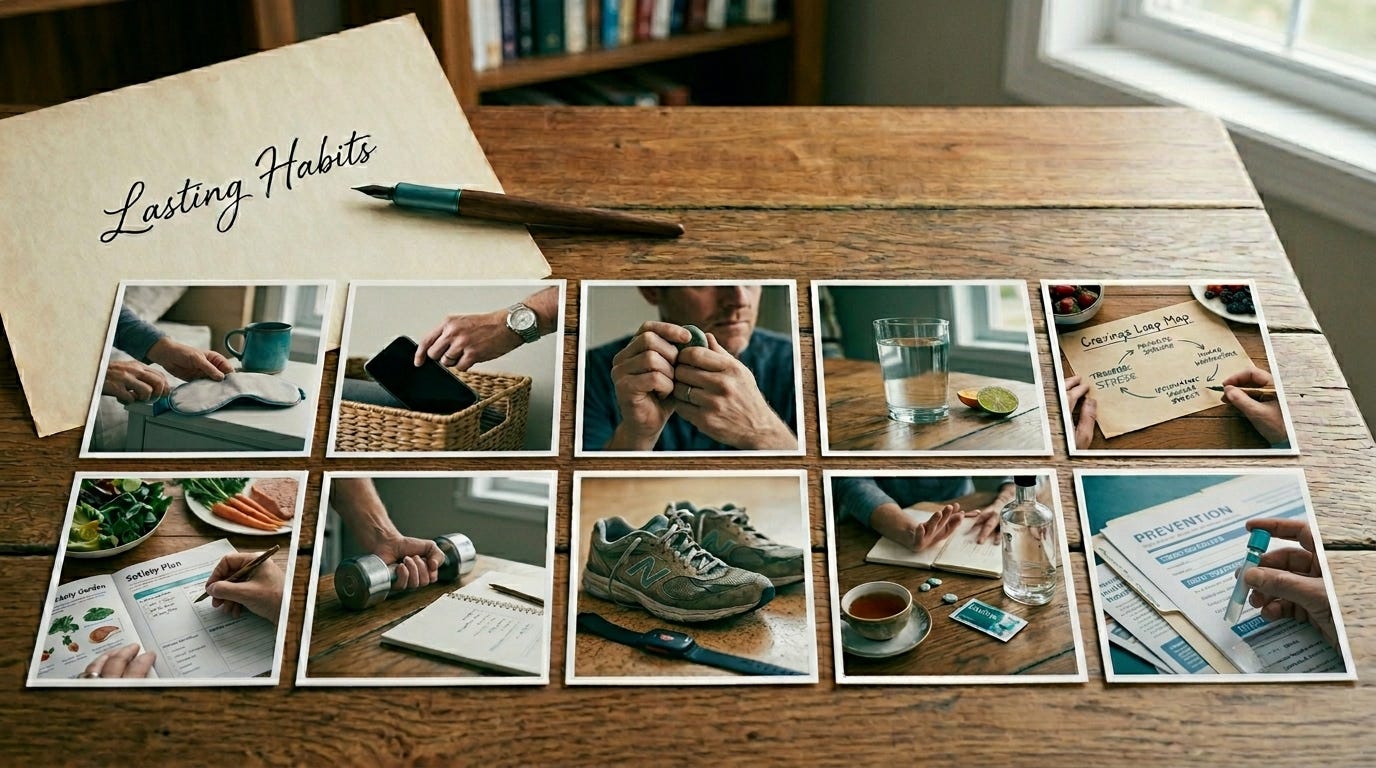
Welcome to the Lasting Habits Series
A once-a-week series of practical, doctor-designed health upgrades you can actually stick with.
Every Saturday, we’ll focus on one lever that makes everything else easier.
Here’s the roadmap:
Week 1 (sleep and recovery) explains how poor or fragmented sleep is often the real reason behind low mood, strong cravings, low energy, and feeling like you “lack willpower.” We covered why late nights and 3 a.m. wake-ups happen, how sleep regulates hunger, blood sugar, stress, and emotional resilience. The solution: a 7-day sleep reset plan, a step-by-step wind-down builder, troubleshooting guide for the most common patterns, and printable sleep reset toolkit.
Week 2 provides you screen boundaries and a brain protection plan. It explains how constant screen use trains the brain to stay in urgency and interruption mode, draining focus, impulse control, sleep, and emotional regulation. We talked about how screens overstimulate the stress system, exhaust the brain’s self-control center, worsen cravings and nighttime restlessness, and undo the benefits of better sleep. The solution: a step-by-step screen boundaries builder, a 3-part “phone rules” system, a dopamine-friendly replacement list, a troubleshooting guide for the most common problems, and a printable screen boundaries brain protection plan.
Week 3 is for people feeling wired, tired, and on edge. It explains why many people feel unable to relax even when nothing is “wrong”: their nervous system is stuck in a half-activated stress state from constant, low-grade demands. We talked about how chronic stress load builds up in the body, disrupting mood, sleep, cravings, and focus, and why this isn’t a willpower issue but a recovery problem. The solution: step-by-step stress resilience reset, a “turn off the alarm” strategy, the 3 most effective nervous system levers (and how to use them depending on your stress type), a stop-the-spiral protocol, and a printable nervous system reset plan you can keep visible—so you don’t have to remember what to do when you’re overwhelmed.
Week 4 covers how aging accelerates when you’re dehydrated (which is most common than people think). It explains how chronic, mild under-hydration can disrupt brain function, digestion, energy, and cravings—and may even be linked to accelerated aging over time. We talked about why thirst is an unreliable signal, how hydration hormones influence metabolic and cardiovascular stress, and why many “I feel off” symptoms improve when fluid intake is stabilized.
Week 5 breaks down why cravings aren’t a discipline failure but a predictable brain response to an ultra-processed food environment designed to keep you on autopilot. We talked about how portion distortion, misleading serving sizes, and hyper-reward foods hijack the brain’s reward system faster than true hunger signals can respond—especially when you’re stressed, tired, or distracted. The solution: a craving loop map to identify your main driver in minutes so you use the right fix instead of guessing (and failing), a troubleshooting guide for the most common patterns, and a printable 7-day autopilot breaker (small daily moves that retrain the default).
Week 6 shows how one simple habit has shaped human survival, from scurvy prevention in the 1700s to wartime “Victory Gardens.” You’ll discover about how fruits and vegetables stabilize appetite hormones, steady blood sugar, support gut–brain signaling, and are linked to lower risks of cardiovascular disease, cancer, depression, and early mortality. The solution: a personalized Mood and Satiety Plan designed around your goals, cravings, schedule, and real-life constraints. You answer targeted questions, and you receive a clear, practical plan that fits your day—so mood feels steadier and meals more satisfying without dieting.
Week 7 reframes strength as independence insurance, the habit that protects your ability to carry groceries, climb stairs, lift suitcases, and keep saying yes to normal life as you age. We’ll talk about how resistance training strengthens not just muscles but your nervous system, balance, mood stability, and long-term health. The solution: a step-by-step Lasting Strength Setup based on adherence strategies that showed promise in randomized controlled trials.
Week 8 shows that it’s never too late to rebuild your cardiovascular engine. Through the story of 92-year-old marathon finisher Mathea Allansmith, we talked about how cardio remains trainable at any age and why longevity depends more on consistency than intensity. The key idea: cardio helps you live longer, strength helps you live better—and the real challenge is building habits that survive real life. The solution: a practical Fitness Tracker that helps you define your starting point, set clear goals, track workouts, steps, body measurements, progress photos, and 30-day and 12-week challenges—so cardio and strength become a routine you can rely on.
Today’s post: surprise surprise!
Upcoming post:
In week 10 we talk about how prevention and early detection can dramatically change health outcomes, from removing precancerous polyps before cancer forms to reversing prediabetes and protecting brain, heart, and bone health long before damage becomes irreversible. The solution: knowing which preventive tests matter and monitoring key risk factors early. Combined with the daily habits from this series, these screenings give you the leverage to detect problems early, reverse risks sooner, and protect the decades ahead instead of reacting when disease finally shows symptoms.
If you’re done managing symptoms on repeat, you’re in the right place. This is the habit foundation most people never get.
Week 9: What Alcohol and Nicotine Steal Over Time—and How to Take It Back
Maya doesn’t know she has a problem.
She simply has a pattern: A drink at night to take the edge off, and a vape when stress spikes. It works fast, so it’s so easy to repeat.
Fast forward ten years:
Version 1: She Changes Nothing
Maya still tells herself it’s “just a drink” and “just a vape.” Not a big deal.
Her sleep still happens, but it’s lighter. She falls asleep fast… then wakes up at 2 or 3 a.m. more often. She’s not exhausted enough to call it insomnia, but she’s tired enough to live in coffee. Her mornings feel a little foggier than they used to.
Her baseline mood changes too. She’s less emotionally resilient, small stressors feel bigger and she gets irritated faster.
Her body composition shifts in a way she can’t fully explain. She eats the same diet, but weight creeps up around the middle. Workouts feel harder to recover from. She moves less because she’s more tired and more sore more often.
Her health markers start to inch in the wrong direction. Blood pressure slightly higher, triglycerides too. Fasting glucose creeping…
Her brain learned a pattern: stress → substance → relief.
So when she’s stressed, the urge shows up automatically, like a reflex.
By year ten, she doesn’t feel “addicted,” and she starts telling herself the most dangerous sentence in health:
“This is just who I am.”
Version 2: She Changes One Thing (and the Benefits Compound)
In this version, Maya doesn’t become “the healthiest person,” but she runs one experiment long enough to feel the difference.
She builds two boundaries she can actually keep:
alcohol becomes occasional and earlier (not nightly and not late)
nicotine stops being her stress button
The first week feels weird, and let’s be honest, sometimes hard.
Then something shifts.
Her sleep deepens. She wakes up fewer times at night, so she feels better through the day and moves more. She still has stress, but she feels less “wired.” Her patience improves, and her mood steadies.
By year ten, she feels calmer. Her health markers trend in the right direction. She enjoys life, but without needing a chemical “off switch” to get there.
Of course she still has hard days, but they don’t automatically become “reach for something.” She has other tools now.
What’s Happening in Your Body (the Physiology, in Plain English)
If you’re reading this and thinking, “Okay… but why do alcohol and nicotine have such an outsized effect?”—here’s the answer.
They change the settings on your sleep system, your stress system, and your brain’s reward-learning system.
And those three systems are the foundation of every lasting habit in this series.
1. Alcohol: The “Sedation Trap” (It Knocks You Down… Then Wakes You Up)
Alcohol is a bit like hitting “force close” on your brain at night. It can make you fall asleep faster, so it feels like it’s helping. But the second half of the night is where the bill arrives.
As your body metabolizes alcohol, sleep becomes lighter and more fragmented. A systematic review and meta-analysis in healthy adults found alcohol before sleep is linked to worse sleep later in the night—more wake time and poorer sleep efficiency, with dose-related effects.¹
Sleep is your recovery factory. If the night is broken, the next day your body behaves differently: more stress-reactive, more craving-prone, more emotionally sensitive, less able to regulate appetite and less likely to exercise consistently
2. Nicotine: a “High-Alert Signal” to Your Nervous System
Nicotine can feel calming because it removes withdrawal discomfort and gives the brain a quick “okay, we’re good” signal—but physiologically, it’s a stimulant input.
Think of it like turning up the “scan for problems” setting. Your body stays a little more ready and activated, but a little less able to fully downshift.
It shows up as feeling wired but tired, restlessness, needing a hit of stimulation to get through stress, sleep that doesn’t feel as deep, and irritability that rises faster than you expect.
And once nicotine becomes your fastest stress tool, it gets reinforced quickly.
Your brain loves fast relief.
3. The Loop That Makes It Sticky: Cue → Relief → Repeat
This is the part most people misunderstand. They think they’re “choosing” alcohol or nicotine in the moment.
But the brain is a prediction machine.
It learns:
stress cue → substance → relief → store that pattern
Soon the urge shows up before you consciously decide. It becomes a reflex.
That’s why these habits can feel “automatic” even in people who are high-functioning and disciplined in other areas.
4. Why Alcohol + Nicotine Together Hit Harder Than People Expect
When you combine them, you’re stacking two powerful inputs:
alcohol pulls you down quickly but can fragment sleep later¹
nicotine nudges your nervous system toward “on”
The result for many people is a very specific pattern:
You feel relief in the moment… but your baseline becomes less steady over time.
And that baseline is everything. A steady baseline is what allows:
consistent workouts
stable appetite
predictable mood
deeper sleep
better recovery
Without it, you spend your days trying to “fix how you feel.”
5. The Heart-and-Vessels Layer
On alcohol, the American Heart Association’s scientific statement emphasizes that alcohol’s relationship with cardiovascular outcomes is complex and dose-dependent, with heavy and binge patterns clearly harmful and “low use” not being a risk-free category for everyone—especially when you zoom out beyond one outcome and consider the full health picture.²
On nicotine delivery systems, the “it’s harmless” story doesn’t hold. An umbrella review in BMJ Open that summarized multiple systematic reviews found that electronic nicotine products have been linked to a range of health harms across different body systems.³ And a 2026 systematic review and meta-analysis specifically examining major adverse cardiovascular events (MACE) addresses cardiovascular outcomes directly, reflecting growing evidence that vaping is not a neutral choice for the heart.⁴
6. The Most Encouraging Part (Especially if You’re Afraid to Stop)
Many people keep nicotine (or smoking) because they fear their mood will worsen.
But evidence doesn’t support that fear. A 2025 review summarizing systematic reviews and meta-analyses reports that smoking cessation is associated with improvements in mental health outcomes, including reductions in depressive symptoms and anxiety.⁵
I won’t lie to you, quitting isn’t easy, but your brain (and body) will feel better than it predicts.
The 7-Day “Remove the Saboteurs” Experiment
Pick one of these experiments for 7 days:
Option A: The Sleep-Protect Alcohol Boundary
No alcohol within 4 hours of bedtime (ideally none on 7 days, but the timing rule alone is a big lever).
Why: alcohol’s second-half sleep disruption is a repeatable pattern in the evidence.¹
Option B: The Nicotine “Stress Button” Swap
If you reach for nicotine when stressed, do 90 seconds of physiological downshift first (4 seconds inhale, 6 seconds exhale × 6 rounds), then decide.
Why: it breaks the cue → automatic relief loop.
Option C: The “Weekend Only” Reset (for alcohol)
Alcohol only on one chosen day (not both Fri+Sat), and keep it earlier.
Why: reduces frequency while protecting sleep.
Option D: The “No Dual Input” Rule
If you drink that day, no nicotine. If nicotine that day, no alcohol.
Why: many people stack them without realizing how much it amplifies dysregulation.
Track just 3 signals (30 seconds/day)
Sleep quality (0–10)
Mood stability (0–10)
Cravings/urges (0–10)
At day 7, ask:
Did my baseline get steadier?
Steady baselines create lasting habits.
I truly hope you find this post, and this series, helpful.
To your zenith within,
Sara Redondo, MD, MS
References:
Gardiner C, Weakley J, Burke LM, Roach GD. The effect of alcohol on subsequent sleep in healthy adults: a systematic review and meta-analysis. Sleep Med Rev. 2025;80:102030. doi:10.1016/j.smrv.2024.102030.
Piano MR, Marcus GM, Aycock DM, Buckman J, Hwang C-L, Larsson SC, et al. Alcohol use and cardiovascular disease: a scientific statement from the American Heart Association. Circulation. 2025;152(1):e7–e21. doi:10.1161/CIR.0000000000001341.
Kaur J, et al. Health impacts of electronic nicotine delivery systems: an umbrella review of systematic reviews. BMJ Open. 2025;15(10):e100168. doi:10.1136/bmjopen-2025-100168.
Al-Rubaye SN, et al. Electronic cigarettes and cardiovascular outcomes: a systematic review and meta-analysis of major adverse cardiovascular events (MACE). BMC Public Health. 2026;26:704. doi:10.1186/s12889-026-26302-x.
Ahmed O, et al. The effects of smoking cessation on the progression of depressive disorders: A systematic review and meta-analysis. Popul Med. 2025.