

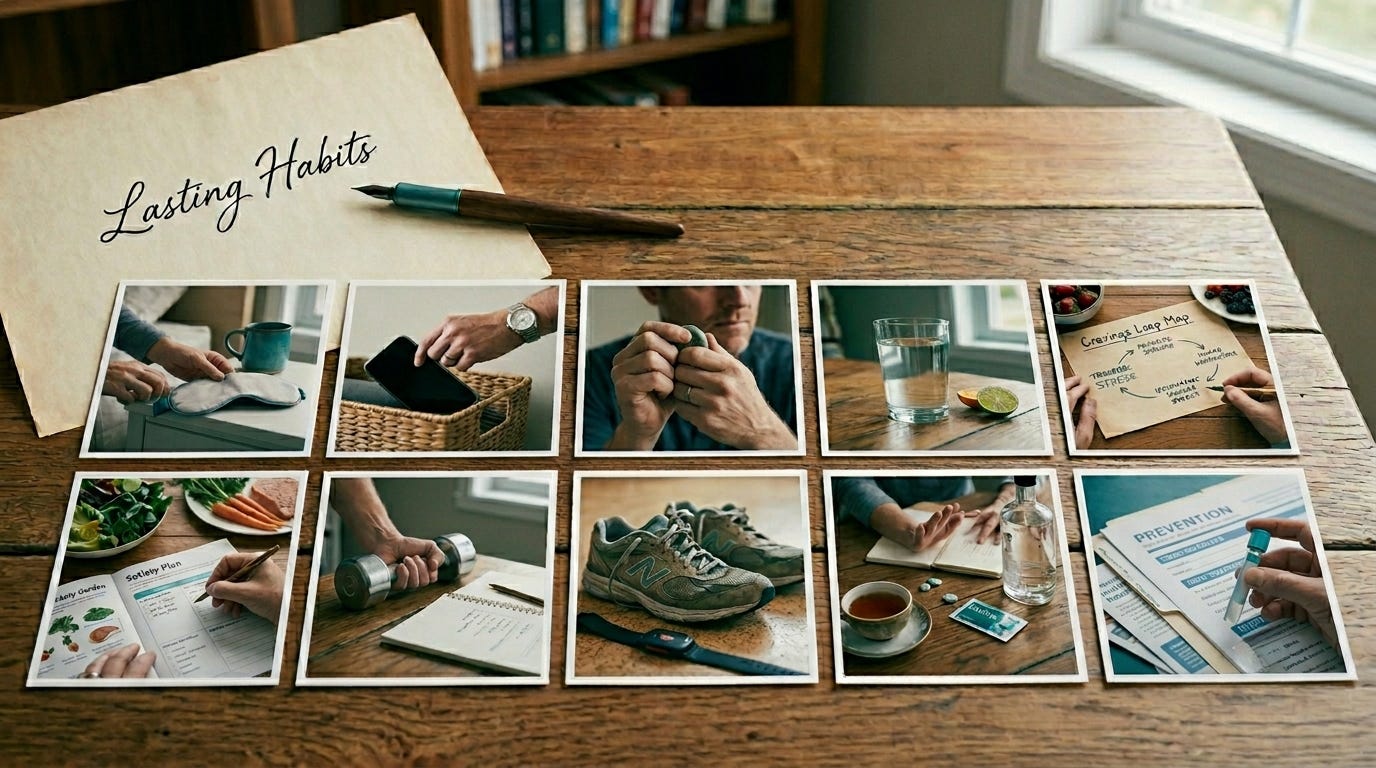
Welcome to the Lasting Habits Series
A once-a-week series of practical, doctor-designed health upgrades you can actually stick with.
Every Saturday, we’ll focus on one lever that makes everything else easier.
*Apologies for not publishing this post yesterday. If you want to support my work (and get all deeper guides), I’d truly appreciate it. Your upgrade directly funds the time, research and writing behind these posts. Thank you.
Here’s the roadmap:
Week 1 (sleep and recovery) explains how poor or fragmented sleep is often the real reason behind low mood, strong cravings, low energy, and feeling like you “lack willpower.” We covered why late nights and 3 a.m. wake-ups happen, how sleep regulates hunger, blood sugar, stress, and emotional resilience. The solution: a 7-day sleep reset plan, a step-by-step wind-down builder, troubleshooting guide for the most common patterns, and printable sleep reset toolkit.
Week 2 provides you screen boundaries and a brain protection plan. It explains how constant screen use trains the brain to stay in urgency and interruption mode, draining focus, impulse control, sleep, and emotional regulation. We talked about how screens overstimulate the stress system, exhaust the brain’s self-control center, worsen cravings and nighttime restlessness, and undo the benefits of better sleep. The solution: a step-by-step screen boundaries builder, a 3-part “phone rules” system, a dopamine-friendly replacement list, a troubleshooting guide for the most common problems, and a printable screen boundaries brain protection plan.
Week 3 is for people feeling wired, tired, and on edge. It explains why many people feel unable to relax even when nothing is “wrong”: their nervous system is stuck in a half-activated stress state from constant, low-grade demands. We talked about how chronic stress load builds up in the body, disrupting mood, sleep, cravings, and focus, and why this isn’t a willpower issue but a recovery problem. The solution: step-by-step stress resilience reset, a “turn off the alarm” strategy, the 3 most effective nervous system levers (and how to use them depending on your stress type), a stop-the-spiral protocol, and a printable nervous system reset plan you can keep visible—so you don’t have to remember what to do when you’re overwhelmed.
Today’s post:
Week 4 covers how aging accelerates when you’re dehydrated (which is most common than people think). It explains how chronic, mild under-hydration can disrupt brain function, digestion, energy, and cravings—and may even be linked to accelerated aging over time. We talked about why thirst is an unreliable signal, how hydration hormones influence metabolic and cardiovascular stress, and why many “I feel off” symptoms improve when fluid intake is stabilized.
Upcoming posts:
Week 5 breaks down why cravings aren’t a discipline failure but a predictable brain response to an ultra-processed food environment designed to keep you on autopilot. We talked about how portion distortion, misleading serving sizes, and hyper-reward foods hijack the brain’s reward system faster than true hunger signals can respond—especially when you’re stressed, tired, or distracted. The solution: a craving loop map to identify your main driver in minutes so you use the right fix instead of guessing (and failing), a troubleshooting guide for the most common patterns, and a printable 7-day autopilot breaker (small daily moves that retrain the default).
Week 6 shows how one simple habit has shaped human survival, from scurvy prevention in the 1700s to wartime “Victory Gardens.” You’ll discover about how fruits and vegetables stabilize appetite hormones, steady blood sugar, support gut–brain signaling, and are linked to lower risks of cardiovascular disease, cancer, depression, and early mortality. The solution: a personalized Mood and Satiety Plan designed around your goals, cravings, schedule, and real-life constraints. You answer targeted questions, and you receive a clear, practical plan that fits your day—so mood feels steadier and meals more satisfying without dieting.
Week 7 reframes strength as independence insurance, the habit that protects your ability to carry groceries, climb stairs, lift suitcases, and keep saying yes to normal life as you age. We’ll talk about how resistance training strengthens not just muscles but your nervous system, balance, mood stability, and long-term health. The solution: a step-by-step Lasting Strength Setup based on adherence strategies that showed promise in randomized controlled trials.
Week 8 shows that it’s never too late to rebuild your cardiovascular engine. Through the story of 92-year-old marathon finisher Mathea Allansmith, we talked about how cardio remains trainable at any age and why longevity depends more on consistency than intensity. The key idea: cardio helps you live longer, strength helps you live better—and the real challenge is building habits that survive real life. The solution: a practical Fitness Tracker that helps you define your starting point, set clear goals, track workouts, steps, body measurements, progress photos, and 30-day and 12-week challenges—so cardio and strength become a routine you can rely on.
Week 9 shows how repeated habits with alcohol and nicotine reshape your sleep, stress response, and reward system over time. Your brain learns the loop stress → substance → relief → repeat. Over time, that loop can destabilize mood, recovery, appetite, and long-term health. The solution: a simple 7-Day “Remove the Saboteurs” Experiment designed to reset your baseline. By testing small boundaries you interrupt the automatic cue-relief cycle and observe how sleep, mood, and cravings shift when your nervous system finally gets a steadier foundation.
In week 10 we talk about how prevention and early detection can dramatically change health outcomes, from removing precancerous polyps before cancer forms to reversing prediabetes and protecting brain, heart, and bone health long before damage becomes irreversible. The solution: knowing which preventive tests matter and monitoring key risk factors early. Combined with the daily habits from this series, these screenings give you the leverage to detect problems early, reverse risks sooner, and protect the decades ahead instead of reacting when disease finally shows symptoms.
If you’re done managing symptoms on repeat, you’re in the right place. This is the habit foundation most people never get.
Aging Accelerates When You Skip This One Daily Habit
A few weeks ago, a patient (I’ll call her Maya) came in convinced something was “off.”
Mid-morning headaches
Afternoon brain fog
Snack cravings that felt weirdly urgent
Constipation that “shouldn’t be happening”
Tired but restless
She had already tried the usual: fancy supplements, less sugar, earlier bedtime, more steps…
Then I asked one question that surprised her:
“Walk me through what you drink from morning to night.”
One coffee, maybe two, and not much water.
We ran basic labs. Nothing alarming.
But her pattern screamed something the medical system often treats like a footnote.
A huge percentage of “I feel off” is actually “I’m under-hydrated,” enough to shift how your brain and body operate.
And the wild part is your thirst doesn’t always warn you in time.
Hydration and Aging: The Detail That Made Researchers Look Twice
Here’s a genuinely eyebrow-raising finding1:
In a large observational analysis, adults with higher “normal-range” serum sodium in midlife (often a proxy for lower hydration over time) had associations with:
Accelerated biological aging markers
Higher risk of chronic disease
Higher premature mortality risk
Important: observational data ≠ proof of causation.
But it’s strong enough that it has pushed hydration into the “healthy aging” conversation in a new way.

The Thirst Hormone With Cardiometabolic Consequences
Your body guards the concentration of your blood like a thermostat guards temperature.
When you don’t drink enough, your blood becomes a little more “concentrated.” Your brain responds by releasing a hormone called vasopressin (also called ADH) to conserve water.
Think of vasopressin as your body’s water-saving mode:
Kidneys hold onto water
Urine gets darker
Thirst may increase (but often late)
That’s the short-term survival win.
But the same system that saves water also talks to metabolism and cardiovascular strain.
There’s growing evidence that higher vasopressin activity (often measured by a stable marker called copeptin) is associated with cardiometabolic risk patterns in different populations. And research is actively exploring how hydration-related hormones influence more than just thirst.2
This doesn’t mean “water fixes everything,” but hydration is upstream, affecting multiple systems at once.
The Thirst Myth: “If I’m Thirsty, I’ll Drink.”
Thirst is useful, but it’s not perfect, especially when:
You’re busy and distracted
You drink lots of caffeine
You’re in cold weather (thirst drops)
You’re older (thirst signaling tends to weaken)
One of the strongest findings in older-adult research is that low-intake dehydration is common in community-dwelling older adults—estimated in a high-quality systematic review/meta-analysis (using serum/plasma osmolality as the reference standard).3
So if you’ve been thinking “I’m not thirsty” — you may still be running slightly low.
“Does Drinking More Water Actually Do Anything?” (The Evidence-Based Answer)
A very solid place to look is randomized clinical trials.
A 2024 systematic review in JAMA Network Open summarized 18 RCTs testing increased daily water intake.
What did they find?
More water was associated with greater weight loss in several trials
and fewer kidney stone events
while single studies suggested possible benefits for migraine prevention, UTIs, diabetes control, and hypotension (but evidence there was limited).4
Translation:
Hydration isn’t a magic wand, but it’s not “just wellness fluff” either.
For certain outcomes (like kidney stones), it’s one of the best habits you can do.
The Hydration Upgrade Almost Nobody Uses: Pair Water With an Existing Habit
This is how hydration becomes automatic.
Pick two anchors you already do daily:
After brushing teeth
While coffee brews
After your first bathroom trip
Before lunch
When you walk into your kitchen at night
Then attach a small, repeatable drink.
The Way Dehydration Shows Up
A lot of people don’t realize the brain can confuse thirst with “I need something,” especially mid-afternoon.
When fluid status dips:
Fatigue rises
Focus drops
Irritability increases
Cravings get louder
Your brain is trying to restore balance and tends to reach for fast solutions.
That’s why so many people feel “snacky for no reason.”
Sometimes the reason is… you’re simply under-watered.
A 48-Hour Experiment That Changes How People Feel Fast
If you want a quick, clean test (without tracking apps):
Do this for 2 days:
Drink water within 30 minutes of waking
Drink a full glass 20–30 minutes before lunch
Drink a full glass mid-afternoon (2–4 p.m.)
That’s it. Then observe:
Headaches
Cravings
Energy stability
Mood reactivity
Constipation
Bedtime hunger
If you notice a difference, you just found a lever.
If you don’t, great—now you can stop guessing and move to the next lever in the series.
If You’re Realizing “I Feel Off” Might Actually Be a Hydration Pattern…
I wrote a deeper post that helps you dial this in without tracking apps or obsessing.
You’ll set a smart personal daily target you can adjust day-to-day, and you’ll get quick scenario guides for exercise, hot weather/humidity, high altitude, and when you’re sick.
I also walk you through hydration needs across life stages—19–64, 65+ (when thirst cues aren’t as reliable), pregnancy, and breastfeeding—so the plan fits your body, not someone else’s rules.
Then we layer in a 60-second self-check, a simple 3-step routine that prevents the afternoon crash, and a printable red-flag list for moments when you need more than water—and exactly what to do.

I truly hope you find this post, and this series, helpful.
To your zenith within,
Sara Redondo, MD, MS
References:
Dmitrieva NI, Gagarin A, Liu D, Wu CO, Boehm M. Middle-age high normal serum sodium as a risk factor for accelerated biological aging, chronic diseases, and premature mortality. EBioMedicine. 2023 Jan;87:104404. doi: 10.1016/j.ebiom.2022.104404.
Koceva A, Janež A, Jensterle M. The impact of hydration on metabolic outcomes: from arginine-vasopressin signaling to clinical implications. Medicina (Kaunas). 2025 May 1;61(5):838. doi: 10.3390/medicina61050838.
Parkinson E, Hooper L, Fynn J, Wilsher SH, Oladosu T, Poland F, et al. Low-intake dehydration prevalence in non-hospitalised older adults: systematic review and meta-analysis. Clin Nutr. 2023 Aug;42(8):1510-1520. doi: 10.1016/j.clnu.2023.06.010.
Hakam N, Guzman Fuentes JL, Nabavizadeh B, Van der Schalie B, Sharma R, Patel M, et al. Outcomes in randomized clinical trials testing changes in daily water intake: a systematic review. JAMA Netw Open. 2024;7(11):e2447621. doi: 10.1001/jamanetworkopen.2024.47621.