

We’re drowning in nutrition information. We’ve outsourced our nutrition decisions to people with large audiences and confident opinions, and the result is that most of us are more confused about food than we were before the information was this available. The clinical evidence on what actually supports health long-term is much more settled than the wellness conversation suggests. It just doesn’t make for good content.
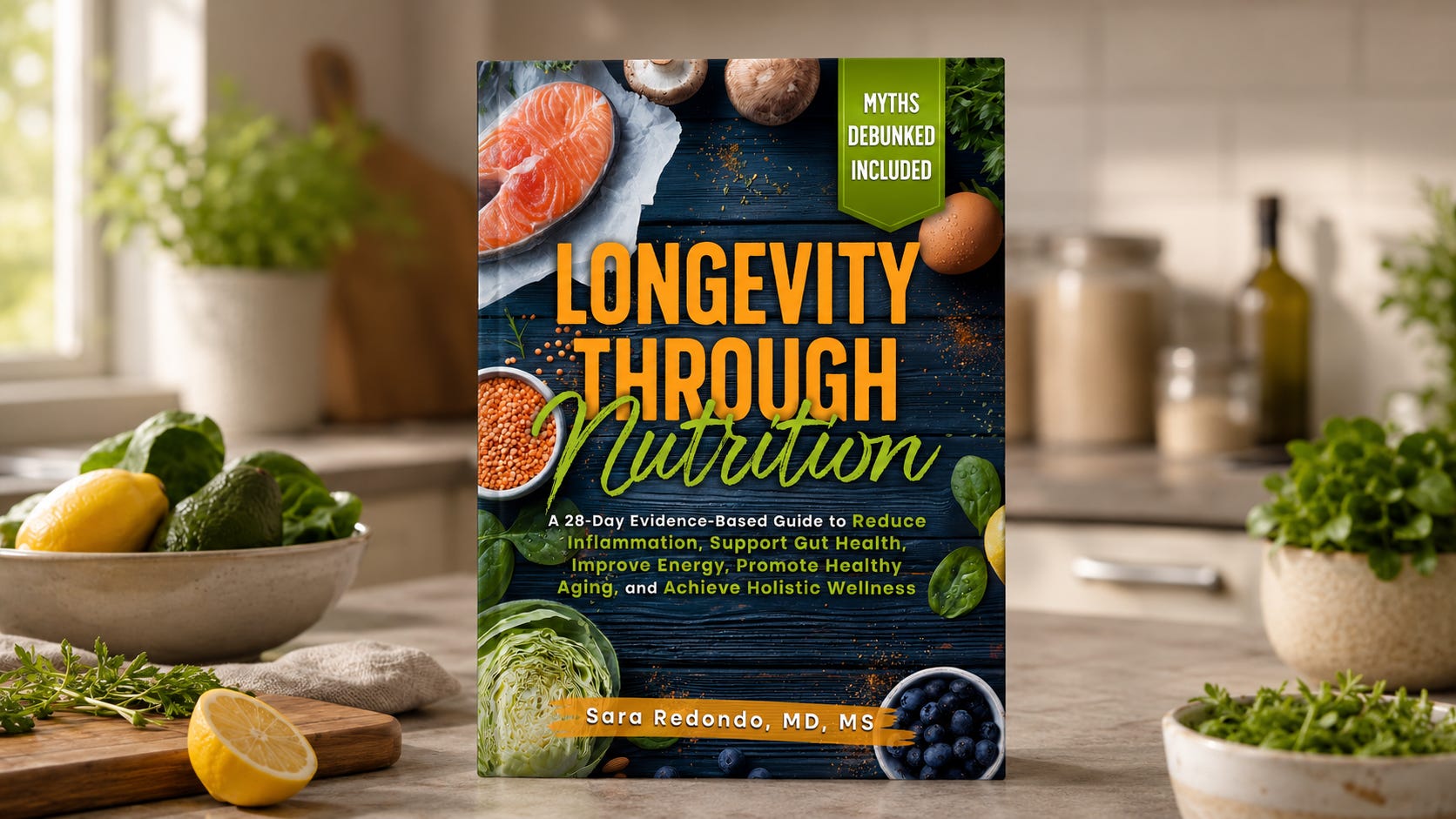
I wrote Longevity Through Nutrition to fix that. A 28-day evidence-based guide to reduce inflammation, support gut health, improve energy, promote healthy aging, and achieve holistic wellness. One chapter per day, organized into four weeks, each one grounded in the research and ending with something practical you can actually do.
Poor nutrition is associated with roughly 1 in 5 deaths worldwide from eating patterns that consistently fall short of what the evidence supports.¹
A Harvard study that followed 105,015 people for 30 years found that those who maintained a healthy dietary pattern from their 40s onward were 45% to 86% more likely to reach 70 in good physical, cognitive, and mental health, free from major chronic disease, compared to those who did not.² Only 9.3% of participants in that study achieved what the researchers defined as healthy aging.
Practical information and a clear place to start are what the book provides.
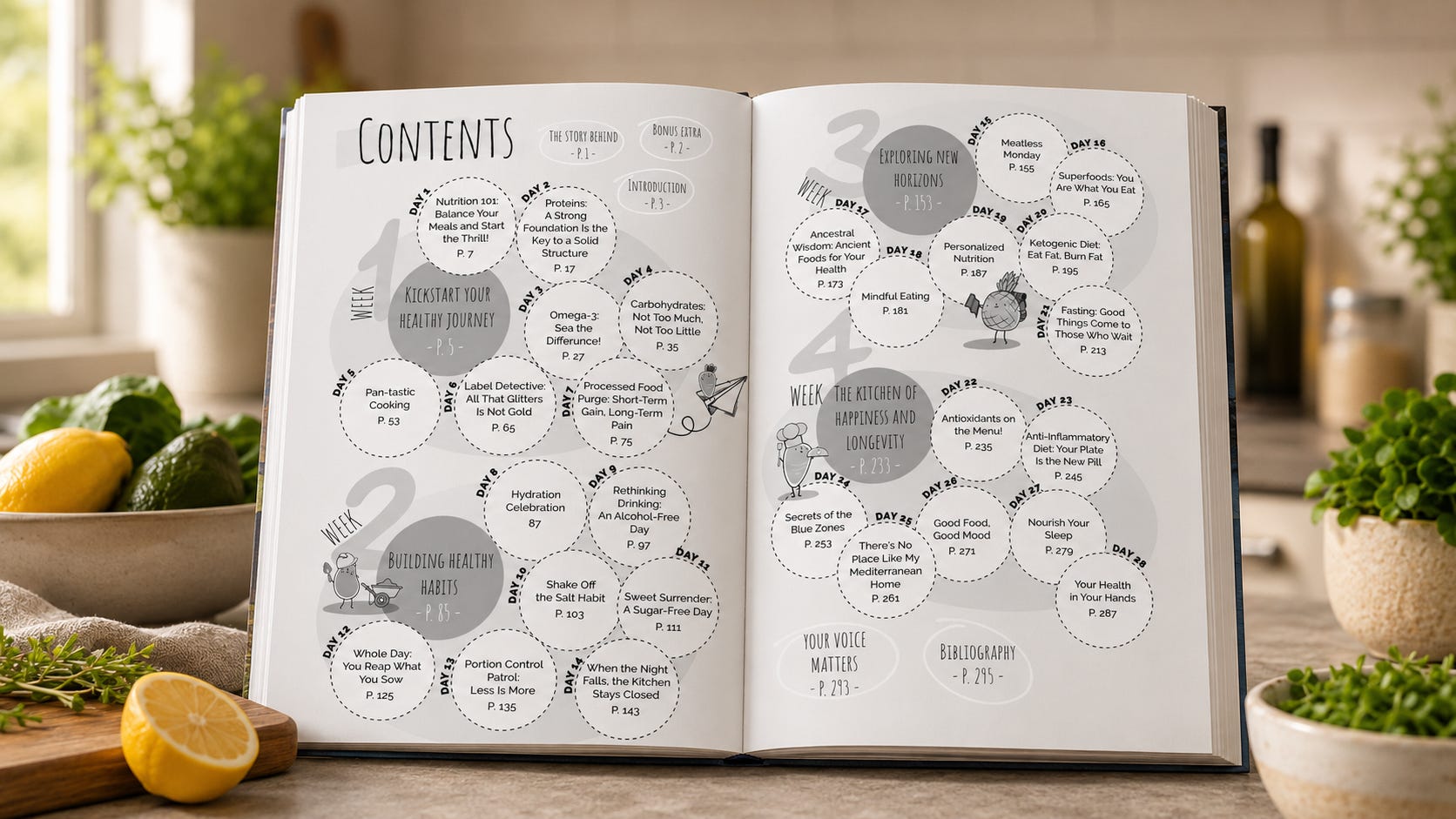
Week 1: Kickstart Your Healthy Journey
The first week is about the fundamentals most people have never had properly explained. Not a list of foods to avoid, but a grounded understanding of what food actually does in the body, and why that matters for how you age.
Day 1: Nutrition 101 : Balance Your Meals and Start the Thrill!
The chapter opens with the two plate models that shape modern nutritional guidance: the Harvard Plate and the US government’s MyPlate. Both agree on the proportions: half the plate for vegetables and fruit, a quarter for whole grains, a quarter for quality protein. Where they diverge matters too, and the book explains why.
Day 1 also lays out the three macronutrient functions through analogies that make the rest of the book’s guidance make intuitive sense. Proteins are the bricks that build the body’s structures; fats are the cement that holds them together; carbohydrates are the electricity that powers everything.
The chapter also introduces a finding that most people have never encountered: the triage theory of micronutrients, which shows that when the body faces nutrient shortage, it prioritizes short-term survival at the expense of long-term aging processes, often silently and for years before anything shows up clinically.
Day 2: Proteins : A Strong Foundation Is the Key to a Solid Structure
Day 2 goes deep on protein: what amino acids do, the difference between complete and incomplete protein sources, and the specific target the evidence supports for adults seeking to preserve muscle and slow biological aging. The general recommended allowance was built to prevent deficiency, not to protect the muscle mass that determines how independently you’ll move through later decades of life.
Day 3: Omega-3 : Sea the Difference!
Fatty fish (salmon, sardines, mackerel, anchovies, herring) are the most evidence-supported source of omega-3 fatty acids, specifically EPA and DHA, the forms the body uses directly. Day 3 covers the cardiovascular, anti-inflammatory, and cognitive evidence, the fish to eat regularly and the ones to limit due to mercury content, and what to know about omega-3 supplementation when dietary intake is consistently low.
Day 4: Carbohydrates : Not Too Much, Not Too Little
Few macronutrients have been more unfairly blamed. Day 4 traces how carbohydrates went from promoted to vilified over six decades of shifting nutritional policy, and why both extremes got it wrong. The chapter clarifies what the evidence actually distinguishes between types of carbohydrates, dismantles common fears around fruit, starchy foods, and blood glucose spikes, and introduces several practical techniques for changing the impact of foods most people eat every day without changing what they eat.
Day 5: Pan-tastic Cooking
How food is cooked changes its nutritional value as much as what goes into the pan.
Day 5 covers cooking techniques across the evidence, which methods preserve micronutrients best, which generate compounds that matter for health, and how to use high-heat methods safely. The chapter also reviews every major cooking material on the market: stainless steel, non-stick coatings, cast iron, ceramic, clay, and others, with a clear breakdown of each one's advantages and limitations.
Day 6: Label Detective : All That Glitters Is Not Gold
Reading a food label is a learnable skill. Day 6 shows how the ingredient list tells you more than the nutrition facts panel, how to identify ultra-processed foods before they reach the checkout, and how common marketing terms work in practice. Most terms like “natural,” “high in fiber,” and “light” aren’t regulated the way most people assume.
Day 7: Processed Food Purge : Short-Term Gain, Long-Term Pain
The last chapter of Week 1 takes an honest look at ultra-processed foods. Not just what they are but why they’re engineered to work against the biological signals that regulate appetite, and what the evidence shows about their role in cardiovascular disease, metabolic disease, anxiety, depression, and all-cause mortality. Week 1 ends with practical replacement strategies that don’t require a complete immediate overhaul of how you eat.
Week 2: Building Healthy Habits
Week 2 moves from what to eat to how to eat it, and what surrounds the eating. The chapters in this week address the habits that most people think of as separate from nutrition but that profoundly shape what the body does with food.
Day 8: Hydration Celebration
Most people underestimate how much their hydration affects their energy, cognitive function, and digestion. Day 8 covers daily fluid targets by life stage, the simple urine color guide that’s more practically useful than tracking ounces, the difference between thirst as a signal and waiting until you’re thirsty, and how to make staying hydrated genuinely easy rather than a task.
Day 9: Rethinking Drinking : An Alcohol-Free Day
Day 9 addresses a topic most nutrition books soften: any amount of alcohol increases cancer risk. The evidence on this is consistent across study types. The chapter covers the mechanisms, the official definitions of drinking patterns that matter clinically, and practical resources and strategies for people who want to reduce or stop.
Day 10: Shake Off the Salt Habit
Sodium and its role in hypertension, with the specific clinical thresholds that matter (above 130/80 mmHg, above 140/90 mmHg depending on the guideline), the main sources of dietary sodium that most people don’t identify, and the flavor alternatives that make reducing salt less of a sacrifice than most people expect.
Day 11: Sweet Surrender : A Sugar-Free Day
Hidden sugars are in far more foods than most people realize, and they go by dozens of different names on ingredient lists. Day 11 covers how to identify them, what the evidence shows about natural versus artificial sweeteners, and one full day’s guidance for eliminating added sugar entirely as a reset and learning experience.
Day 12: Whole Day : You Reap What You Sow
Day 12 is dedicated entirely to whole grains. The chapter takes on one of the most widespread myths in modern nutrition: that gluten-free eating is healthier for everyone. It also covers the labeling myth that "whole grain" always means healthy, with practical guidance on how to identify the real thing and a comparison of the most evidence-supported grain types.
Day 13: Portion Control Patrol : Less Is More
Not about calorie counting, but about understanding the signals the body uses to regulate eating, why those signals get overridden by ultra-processed food design, and the practical visual and behavioral tools that work better than precise measurement for most people in real life.
Day 14: When the Night Falls, the Kitchen Stays Closed
Day 14 introduces the chrono-nutrition angle: eating late at night consistently impairs metabolic function regardless of total caloric intake. The chapter covers the evidence on kitchen closing time, the mechanisms behind why late eating matters, and how to use this as a practical tool for blood glucose management, sleep quality, and weight.
Week 3: Exploring New Horizons
Week 3 opens the scope of the book. The chapters move beyond individual foods and meals into dietary patterns, specific populations, and evidence-based reviews of approaches that get a lot of attention in the public conversation.
Day 15: Meatless Monday
The evidence on plant-based eating for longevity is compelling, but the chapter is honest about what it means in practice. Day 15 covers plant protein quality, how to combine plant sources to cover all essential amino acids, and one practical meatless eating day as both an experiment and a habit entry point.
Day 16: Superfoods : You Are What You Eat
Not all foods marketed as superfoods have clinical evidence behind them, and not all of the ones that do require expensive supplements. Day 16 applies evidence criteria to the most commonly discussed foods in this category: turmeric, berries, green tea, and others. The chapter separates what the evidence supports from what the marketing claims.
Day 17: Ancestral Wisdom : Ancient Foods for Your Health
Three ancient traditions arrived at the same core insight independently: Hippocrates in ancient Greece, Traditional Chinese Medicine, and Ayurveda all understood that food, plants, and lifestyle were the foundation of preventing disease, not just treating it. Day 17 takes that legacy seriously and examines it against modern clinical evidence.
Day 18: Mindful Eating
Eating quickly, without attention, while distracted consistently leads to overeating and dysregulated hunger signaling. Day 18 covers the evidence on eating pace, screen-free meals, and hunger and satiety awareness as practical skills. The chapter also includes the first validated tool for measuring mindful eating in the general population, a meaningful development in the field because it means the practice can now be assessed and tracked rather than simply described.
Day 19: Personalized Nutrition
No single dietary pattern is optimal for everyone. Day 19 provides tailored guidance for specific health goals (weight management, muscle gain, cardiovascular health, metabolic disease management, bone health, mental health) and specific life stages (pregnancy, breastfeeding, menopause, athletic performance, older adults).
Day 20: Ketogenic Diet : Eat Fat, Burn Fat
An honest clinical review of ketogenic eating, including where the evidence is strong, where it’s limited, and what the trade-offs are for different people. Day 20 doesn’t advocate for or against keto. It applies the same evidence standard the rest of the book uses.
Day 21: Fasting : Good Things Come to Those Who Wait
The evidence on intermittent fasting, time-restricted eating, and more extended fasting approaches, reviewed against the clinical data. What works, who benefits most, the connection to circadian rhythm that makes this more than just calorie reduction, and the practical protocols with the best evidence.
Week 4: The Kitchen of Happiness and Longevity
The final week is where everything the book has built comes together. The chapters in Week 4 cover the clinical evidence for the dietary patterns that most reliably support healthy aging, the gut-brain connection, and the relationship between what you eat and how you sleep and how you feel.
Day 22: Antioxidants on the Menu!
Free radical damage and oxidative stress are central to most theories of aging. Day 22 explains the mechanism, the food sources with the best clinical evidence for antioxidant activity (the same ones that appear in every longevity-associated dietary pattern), and why isolated antioxidant supplements have largely failed where food sources succeed.
Day 23: Anti-Inflammatory Diet : Your Plate Is the New Pill
A striking finding that shapes this chapter: 57% of US adults follow dietary patterns that promote chronic inflammation. The connection between that inflammation and the diseases that determine quality of life later (metabolic disease, cardiovascular disease, cancer, autoimmune conditions, mood disorders) is the subject of a growing body of clinical evidence. Day 23 presents the anti-inflammatory dietary framework in practical terms, the foods to build around, and what to reduce.
Day 24: Secrets of the Blue Zones
The five regions where people consistently live longest and retain health and function: Ogliastra in Sardinia, Italy; Ikaria, Greece; Okinawa, Japan; the Nicoya Peninsula in Costa Rica; and Loma Linda in California. Day 24 covers what their diets actually look like, the non-dietary factors that matter as much as food, and the Okinawan concept of Hara Hachi Bu.
Day 25: There’s No Place Like My Mediterranean Home
As a Spanish physician, this chapter carries personal weight for me. The Mediterranean diet is the most extensively studied dietary pattern in the world, and the evidence is genuinely remarkable.
The PREDIMED trial, one of the largest randomized controlled trials of a dietary intervention ever conducted, followed 7,447 adults at cardiovascular risk and found that a Mediterranean diet supplemented with extra virgin olive oil or nuts reduced the risk of major cardiovascular events by approximately 30% compared to a low-fat control diet.³ The same dietary pattern has since been associated with reduced rates of type 2 diabetes, several cancers, depression, neurodegenerative disease, and all-cause mortality. Day 25 translates this evidence into a practical guide to what Mediterranean eating actually looks like, with a validated questionnaire to measure adherence.
Day 26: Good Food, Good Mood
The gut microbiota influences the production of neurotransmitters, the regulation of the stress response, and the permeability of the gut barrier in ways that connect directly to anxiety, depression, and resilience. Day 26 covers the gut-brain axis in clinical detail, and the dietary patterns that support it.
Day 27: Nourish Your Sleep
The relationship between diet and sleep quality is bidirectional and underappreciated. Certain foods contain melatonin or its precursors directly. Magnesium deficiency, which affects a substantial proportion of the population, is independently associated with poor sleep quality. Eating late and eating high-glycemic foods close to sleep consistently impairs sleep architecture. Day 27 covers the evidence on nutritional sleep support alongside the better-known behavioral principles.
Day 28: Your Health in Your Hands
The final chapter is a consolidation. It summarizes the habits the book has built over 28 days, shows how they interact with each other rather than functioning as isolated behaviors, and gives a framework for continuing beyond the month.
The message the chapter ends on is the same one the book opens with: living to 70 with good health, free from major chronic disease, isn’t a matter of luck. The evidence on what separates the 9.3% who achieve that from the rest is specific, actionable, and available.
What Changes After 28 Days
Each chapter introduces one concept or practice, explains the evidence behind it, and leaves you with something you can apply that day.
By Day 7, you have a working understanding of what macronutrients do and why ultra-processed foods undermine them. By Day 14, you have a practical framework for hydration, alcohol, salt, sugar, and meal timing. By Day 21, you’ve been through an honest evidence review of the dietary patterns that get the most public attention. By Day 28, the anti-inflammatory diet, the Mediterranean pattern, the Blue Zones principles, the gut-brain connection, and the sleep-nutrition relationship are all in place.
More than 5 billion people worldwide don’t consume enough essential micronutrients, simply because of the pattern of what they eat.⁴ The gap between what the evidence supports and what most people actually eat is real. The book is your bridge.
Start Here
The downloadable below helps you see where your current patterns stand against what the evidence shows works. Most people who complete it discover at least one significant gap they weren’t aware of.
To your zenith within,
Dr. Sara Redondo
P.S. To the health professionals I've had the privilege of meeting here on Substack. Thank you Dr Mehmet Yildiz, Jimi Francis, Karina Baloleanu, CFNC, Sophia Deahl, MS, RD, IFMCP, Danni Macfarland, David Dansereau, MSPT, Emily Roach, Sophie Guénon, MS, Dove Wilson, Dr. Bronce Rice, Pamela Cotton, Ph.D., Philipp Maerzhaeuser, The Health Emporium, and Emily Horstman, RD for being part of this.
References:
GBD 2017 Diet Collaborators. Health effects of dietary risks in 195 countries, 1990–2017: a systematic analysis for the Global Burden of Disease Study 2017. Lancet. 2019;393(10184):1958-1972. doi:10.1016/S0140-6736(19)30041-8
Tessier AJ, Wang F, Korat AA, Eliassen AH, Chavarro J, Grodstein F, et al. Optimal dietary patterns for healthy aging. Nat Med. 2025;31(5):1644-1652. doi:10.1038/s41591-025-03570-5
Estruch R, Ros E, Salas-Salvadó J, Covas MI, Corella D, Arós F, et al. Primary prevention of cardiovascular disease with a Mediterranean diet supplemented with extra-virgin olive oil or nuts. N Engl J Med. 2018;378(25):e34. doi:10.1056/NEJMoa1800389
Passarelli S, Free CM, Shepon A, Beal T, Batis C, Golden CD. Global estimation of dietary micronutrient inadequacies: a modelling analysis. Lancet Glob Health. 2024;12(10):e1590-e1599. doi:10.1016/S2214-109X(24)00276-6
Kitchen happiness is such a key foundation. Understanding how to nourish ourselves and learn the tools to do so is empowering.