

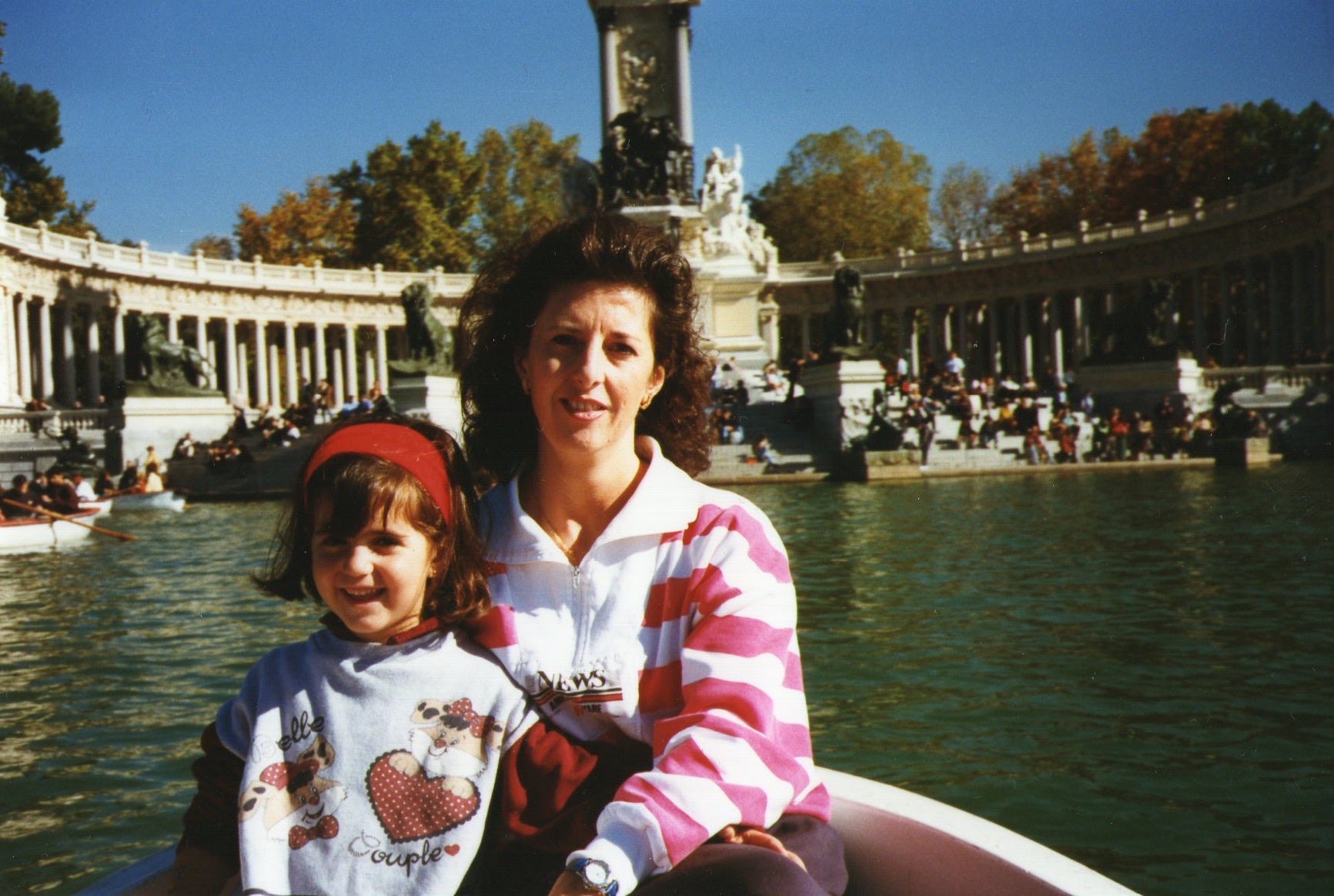
I lost my mother when she was 56. I was 22. We had just finished our exams from medical school and I received a call from my father: “We have to see mom.” That day she told me she had been diagnosed with lung cancer and metastasis. Within a year, she was gone.
It completely broke me. I didn’t know how to carry that kind of pain. I didn’t want to see anyone, not even my own family. Every time we gathered around the table, all I could see was the empty chair where she should have been. When I finally reached out for help, all I received was a prescription.
No one teaches us how to grieve. Even in medicine, we learn how to diagnose, how to treat, how to prolong life… but almost nothing about what happens after loss.
And yet grief is one of the few experiences that every human being will face. Sooner or later, it touches every one of us.
There’s a good chance you’ve lost someone too. So today, in honor of all those we carry with us, I want to open a conversation about what grief really is, why it feels the way it does, what the research actually says, and how people slowly, imperfectly, learn to live alongside it.
If you want to share your story, I’d love to read you.
Why We’re so Unprepared
Every person who has ever loved something — a person, a relationship, a version of their life — will grieve its loss. And yet it’s one of the least talked-about things in everyday life.
We avoid it partly because it frightens us. Someone else’s grief is a reminder of our own eventual losses. So we change the subject, offer platitudes, and wait for the grieving person to seem “better.” The grieving person learns quickly not to bring it up. The silence compounds the loss.
What gets left unsaid is that grief is not a problem to solve.
What the Research Actually Says
Elisabeth Kübler-Ross introduced five common phases of grief in her 1969 book On Death and Dying.1 The model is widely quoted, and just as often misunderstood.
Kübler-Ross never meant the stages to be a linear sequence. She described them as possible emotional responses, not a checklist. Some people skip stages, return to them, experience them simultaneously, or don’t go through some of them at all.
Here’s a clear, grounded way to understand them:
Denial
In the early moments after a loss, many people describe a strange sense of unreality, as if they’re watching their life from the outside.
You might intellectually understand what happened, but emotionally it hasn’t landed yet.
Denial is your brain protecting you from emotional overload, allowing you to approach the pain at a pace you can survive. Part of you knows the truth, while another part keeps expecting things to go back to normal. You might catch yourself thinking you’ll see the person again, or momentarily forgetting they’re gone.
There can be numbness, shock, or disbelief. Thoughts like “This can’t be real” are common, and daily life may continue on autopilot.
This state gives you time to absorb the impact gradually instead of all at once.
Anger
As reality begins to settle in, emotional energy often rises. That energy can take the form of anger.
It may be directed at others, at circumstances, at the person who died—or at no clear target at all. Irritations can feel amplified. Questions like “Why did this happen?” may surface repeatedly.
Underneath, there is usually a mix of helplessness (I couldn’t stop this), injustice (this shouldn’t have happened) and fear (if this can happen, nothing is safe).
Anger can also carry guilt, especially when it’s directed toward the person who died.
Bargaining
This is where guilt often intensifies. It’s a deeply cognitive phase, dominated by loops of thinking that try to rewrite the past.
You may find yourself reconstructing timelines: what you said, what you didn’t say, what signs you might have missed. Even when you logically know the outcome wouldn’t have changed, the mind keeps searching.
Your mind tries to regain control.
“If only…” thoughts (“If I had done X, maybe this wouldn’t have happened”) can dominate you, as well as replaying scenarios over and over.
This is the brain trying to rewrite the story to reduce helplessness.
Depression
At this stage, the weight of the loss becomes more fully felt.
Energy drops. Motivation fades. Social interaction may feel draining. You may just want the world to slow down.
Physically, the body mirrors this state: fatigue, changes in sleep, appetite shifts, a general sense of low vitality.
It’s important to distinguish this from clinical Depression. Grief-related depression is tied to the loss, and it still allows moments of connection or relief.
This phase reflects the true weight of the loss. It’s where processing really deepens.
Acceptance
It emerges gradually. What changes is not the fact of the loss, but your relationship to it.
You begin to notice that the pain, while still present, is less constant, you can think about the person without being completely overwhelmed, life starts to include other emotions again—interest, curiosity, even joy.
Acceptance includes what psychologists call continuing bonds. You don’t “let go” of the person, you find new ways to relate to their memory, their meaning, their impact on your life.
There’s also a shift in identity. After a significant loss, who you are changes. Acceptance involves slowly building a life that includes both what was lost and what is still possible.
Moments of grief become more integrated, less disruptive, more woven into the fabric of everyday life.
More recent grief research has moved toward what psychologists call the dual process model2 — the idea that grieving people oscillate between loss-orientation (actively processing the loss) and restoration-orientation (attending to life changes, distractions, rebuilding). Both are necessary. Neither should dominate entirely.
The person who only processes and never rebuilds gets stuck. The person who only rebuilds and never processes doesn’t actually grieve.
There’s no standard timeline. Grief after a sudden loss often hits differently than grief after a long illness. Complicated grief — where the loss becomes so absorbing that it prevents functioning — affects roughly 10 percent of bereaved people and is now recognized as a clinical condition worth treating.3
The Five Regrets They Don’t Mention Until the End
Bronnie Ware spent years working as a palliative care nurse in Australia. When she began writing about what her dying patients told her, she didn’t expect much response. The blog post went viral. The book that followed — The Top Five Regrets of the Dying4 — has now been translated into 32 languages.
They spent too much time being who others wanted them to be. Agreeing to things they didn’t believe in. Shaping their lives around approval they weren’t sure they even wanted.
They sacrificed joy for work that didn’t fulfill them. Not work that was meaningless, most of them had careers they’d committed too seriously. But the hours given to that work came at the expense of other things that turned out to matter more. Time they didn’t get back.
They swallowed their feelings instead of speaking their truth. Unspoken conversations. Things that stayed unsaid because the moment felt wrong, or the relationship felt fragile, or they kept waiting for a better time. By the end, the waiting had become permanent.
They let friendships fade when they needed them most. Not through betrayal. Through drift. The slow attrition of not calling back, not prioritizing the visit, telling themselves they’d reconnect when things settled down.
They waited too long to allow themselves to be happy. As though happiness were something that had to be earned or deserved or arrived at by circumstance. They kept it contingent — on the job, the relationship, the circumstances improving. The circumstances didn’t always improve.
What’s striking about these regrets is that they’re about what people failed to feel, say, and allow. The losses that sting at the end are rarely material.
This matters for grief because many of these regrets compound loss. When someone dies and there were things left unsaid, the grief carries an extra weight — not just mourning the person, but mourning the conversation that never happened. The visit that kept getting postponed. The version of the relationship that might have existed.
How to Move Through It
There is no technique that makes grief easier. Anyone selling a quick fix to grief is selling something else. But there are things that help people move through it rather than around it.
Name what you’re feeling with some precision. “Grief” is a broad container. Inside it there might be sadness, yes — but also anger, relief, guilt, longing, fear, or gratitude. These don’t cancel each other out. Naming them more specifically tends to make them less overwhelming. Saying “I’m angry that he left without us resolving that argument” is different from sitting with a diffuse, nameless heaviness.
Write down what you’re actually feeling right now. Give yourself five minutes and don’t edit. Angry at a dead person is allowed. Relieved is allowed. Numb is allowed.
Let the grief be inconvenient. One of the ways people get stuck is by only allowing grief in designated spaces — the cemetery, the therapy session, the night when they’re alone. Grief will surface in the supermarket, on a Tuesday, during a meeting. Trying to contain it too tightly often just delays it.
Identify one place or situation where you regularly suppress grief because it feels inconvenient. Notice it without judgment. You don’t have to act differently, just notice.
Find at least one person who can hold it with you. Just sit with the weight of it. Research on social support and bereavement is consistent: isolation worsens grief outcomes.5 Not because company solves anything, but because being witnessed matters.
Think of one person in your life who has the capacity to simply listen. If you can’t name one, that’s worth knowing too.
Stay in contact with ordinary life. Not to escape grief, but because ordinary life is part of how humans process loss. Tending to something small — a plant, a routine, a meal — isn’t a betrayal of the person you lost. The dual process research suggests this oscillation is healthy, not avoidant.
If grief is interfering with your ability to function for an extended period, that’s worth taking seriously. Complicated grief is treatable. Seeking help for it is not a sign of weakness or of loving the person less.
If you’ve been grieving for more than six months and it still feels as acute as it did initially, or if it’s preventing you from engaging with daily life, consider speaking with a grief counselor or therapist.
The Thing Nobody Says
Grief doesn’t end. This is what people are most afraid to hear, and also the most honest thing that can be said about it.
What changes is not the existence of the grief but its texture. A loss that is raw and destabilizing in the early months often becomes, over years, something more like a scar — present, part of the landscape of a life. People who’ve lost someone they loved don’t stop loving them. They learn, slowly and imperfectly, to carry that love somewhere it can coexist with continuing to live.
To your zenith within,
Sara Redondo, MD; MS
References:
Kübler-Ross E. On death and dying. New York: Macmillan; 1969.
Stroebe M, Schut H. The dual process model of coping with bereavement: rationale and description. Death Stud. 1999;23(3):197–224. doi:10.1080/074811899201046.
Lundorff M, Holmgren H, Zachariae R, Farver-Vestergaard I, O’Connor M. Prevalence of prolonged grief disorder in adult bereavement: a systematic review and meta-analysis. J Affect Disord. 2017;212:138–49. doi:10.1016/j.jad.2017.01.030.
Ware B. The top five regrets of the dying: a life transformed by the dearly departing. Sydney: Balboa Press; 2011.
Holt-Lunstad J, Smith TB, Baker M, Harris T, Stephenson D. Loneliness and social isolation as risk factors for mortality: a meta-analytic review. Perspect Psychol Sci. 2015;10(2):227–37. doi:10.1177/1745691614568352.
Your piece here is so valuable and clear in how to help oneself and others along the way to being able to reclaim one’s life, even knowing that the missing never goes away.
Thanks so much for sharing this Sara. I’m sorry to hear of your Mum’s passing. My experience was similar - I was 27 and Mum was just 60 when she died from Lymphoma. She was diagnosed with approx. 6 months but passed away 4 weeks later. I’ve recently been exploring this myself (I’m now 45 but my grief resurfaced when I had my children) and have begun writing more about it. It’s so key for people to know that grief will touch us all and can be journeyed through so differently 💛