
The Truth About Osteoporosis Most People Miss
Osteoporosis often stays silent until a fracture happens. Discover the overlooked risks, warning signs, and steps to protect your bones at any age

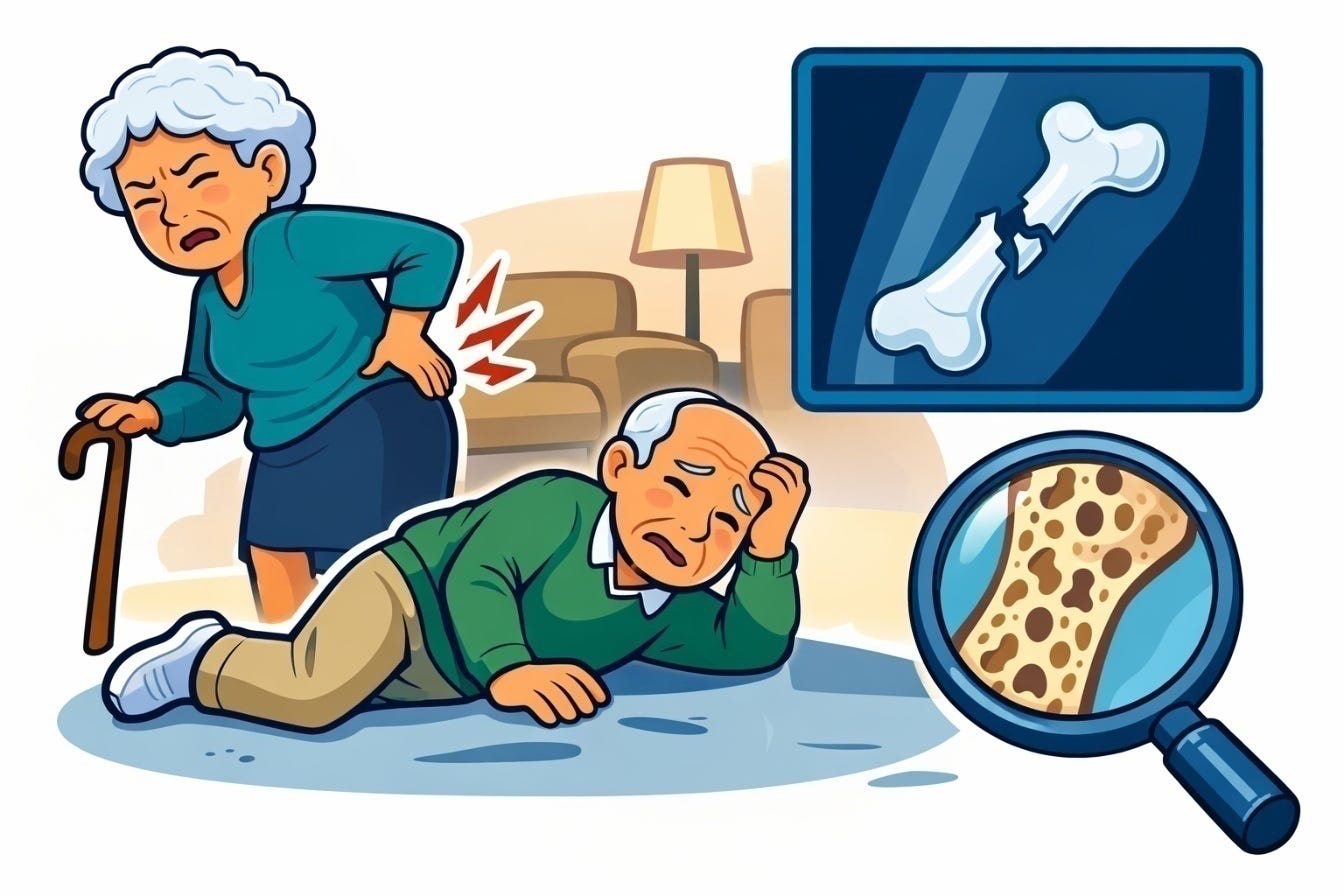
She fell reaching for a coffee mug.
Margaret, 67, was standing in her kitchen, reached across the counter, and felt something give in her wrist. The ER confirmed a fracture. Her doctor ordered a bone density scan. The result came back: severe osteoporosis.
She had no idea. Her bones had been quietly losing density since her early 50s, and nothing about her daily life had told her so.
Her story is ordinary. That’s the problem.
Osteoporosis affects an estimated 200 million people worldwide.1 In the United States alone, approximately 10 million people have the condition, and another 44 million have low bone density that puts them at risk.2
Most of them, like Margaret, have no symptoms until something breaks.
Studies show that roughly 20 to 30% of older adults who suffer a hip fracture die within a year — from complications like pneumonia, blood clots, and the rapid physical decline that follows prolonged immobility.3
The disease is preventable, in many cases, and treatable, once diagnosed.
1. What Is Actually Happening Inside the Bone
Bone is constantly being broken down and rebuilt in a process called remodelling.
Specialised cells called osteoclasts dissolve old bone; osteoblasts build new bone in its place. In healthy adults, this cycle stays roughly balanced.
Osteoporosis happens when that balance tips.
Breakdown outpaces rebuilding. The internal structure of the bone — which looks like a dense honeycomb under a microscope — becomes progressively more porous and fragile. Bone mineral density (BMD) drops, and with it, the bone’s ability to absorb impact.4
The process is slow and completely silent. There’s no pain while it’s happening. The first clinical sign is often the fracture itself — typically in the wrist, spine, or hip.
Bone density peaks in your late 20s to early 30s. After that, it gradually declines for everyone.4 The rate of loss accelerates significantly in women after menopause due to the drop in estrogen, which plays a key role in regulating bone remodelling. Men lose bone more slowly but are not exempt — and because osteoporosis is often thought of as a women’s disease, men tend to be diagnosed later and treated less aggressively.3
Action step: If you’re a woman over 65, or a man over 70, ask your doctor about a DEXA scan — the standard bone density test. If you have risk factors (smoking, family history, low body weight, corticosteroid use), the conversation should happen earlier.
2. The Risk Factors Most People Overlook
Age and sex are the most cited risk factors. They’re real but incomplete. Several other contributors are commonly underestimated, and some are reversible.
Corticosteroid medications — prescribed for conditions like asthma, rheumatoid arthritis, and inflammatory bowel disease — significantly accelerate bone loss when taken long-term. Patients on long-term oral corticosteroids have fracture rates 2 to 5 times higher than those not taking them.5
This is one of the most common drug-related causes of osteoporosis, and one of the most frequently missed in clinical practice.
Calcium and vitamin D deficiency are also significant contributors. Vitamin D is essential for calcium absorption in the gut, and deficiency is widespread.
Up to 95% of the United States population has a vitamin D deficiency,6 with levels even higher in many European countries.7
Without adequate vitamin D, the body cannot properly use the calcium it takes in, regardless of how much dairy or supplementation is involved.
Other commonly underestimated risk factors include:
Smoking
Alcohol consumption
Very low body weight
Prolonged physical inactivity
Family history of osteoporosis or hip fracture
Eating disorders deserve specific mention — conditions like anorexia nervosa can cause significant and sometimes irreversible bone loss even in young people, as sustained low caloric intake deprives bone of the nutrients needed for remodelling.4
Secondary causes are also worth understanding. Hyperthyroidism, malabsorption conditions such as coeliac disease, and early menopause (before age 45) all increase risk considerably. Many patients with osteoporosis have an underlying secondary cause that, once identified and managed, can slow bone loss substantially.
Action step: Make a list of your personal risk factors before your next medical appointment. Corticosteroid use, smoking history, low dairy or calcium intake, family history of fracture — bring it in writing. It changes the conversation.
3. What the Evidence Says About Screening
The central challenge with osteoporosis is that it produces no symptoms until a fracture occurs.
This makes systematic screening critical, yet uptake remains low. Internationally, the most widely used screening tool is the DEXA (dual-energy X-ray absorptiometry) scan, which measures bone mineral density at the hip and lumbar spine and produces a T-score.4
Reading your T-score:
T-score ≥ −1.0: Normal bone density
T-score −1.0 to −2.5: Osteopenia (low bone density, not yet osteoporosis)
T-score ≤ −2.5: Osteoporosis
It’s worth noting that T-scores capture density, not architecture. Two people with the same score can have very different fracture risk depending on other factors. This is why the FRAX tool (fracture risk assessment tool) was developed — it integrates T-score data with clinical variables including age, sex, BMI, smoking status, alcohol use, and steroid use to calculate a 10-year probability of fracture.3
For most people, the first DEXA scan is the most important step because it establishes a baseline. Without a baseline, there’s no way to know whether bone density is stable, improving, or declining over time.
Action step: If you’ve never had a DEXA scan and you’re over 65 (women) or 70 (men) — or younger with risk factors — ask your GP or internist to refer you. The scan is quick, painless, and low-radiation. Most guidelines recommend it as a routine part of care for these age groups.
4. Exercise, Nutrition & Medication
Not all exercise is equally useful for bone.
Weight-bearing activity — walking, hiking, resistance training — stimulates bone formation through a process called mechanotransduction, whereby mechanical stress on bone triggers osteoblast activity.3
Swimming and cycling, despite being excellent for cardiovascular health, have minimal effect on bone density because the water or bike supports body weight, removing the mechanical stimulus.
Resistance training is the most consistently studied and effective form of exercise for improving bone mineral density, particularly at the hip and spine.8 High-impact activities such as jumping and running also generate strong osteogenic signals, though they must be approached carefully by those already diagnosed with osteoporosis due to fracture risk.
On the nutrition side, protein, calcium and vitamin D are the nutrients most associated with bone health — but the supplement research is more nuanced than the supplement aisle suggests.
For people with significant bone loss, lifestyle measures alone are often insufficient.
There are effective medications — bisphosphonates, denosumab, and anabolic agents — with strong evidence behind them, though they come with trade-offs worth understanding carefully.9
5. The Strong Bones Blueprint
Today, you’ll get a downloadable with:
A simple framework for testing and tracking your bone health, including how to interpret DXA scans, FRAX scores, and lab tests worth requesting.
A bone-supportive nutrition guide with the key nutrients to focus on, the best food sources, and a 7-day meal plan designed to nourish your skeleton.
A progressive resistance training program to help send the “build bone” signal, along with balance work to reduce fall risk.
Lifestyle upgrades that matter more than most people realize—better sleep, lower stress, less alcohol, no smoking, and a safer home environment.
A medication guide to help you think more clearly about your options and the conversations worth having with your doctor.
A 30-day action plan designed to get all four pillars — nutrition, exercise, lifestyle, and monitoring — into motion in the first month.
A sustainable long-term strategy so you can protect your bone health for the years ahead.
Upgrade now to download The Strong Bones Blueprint.