
The Pesticide Myth: When “Safe” Levels Become Dangerous
Are pesticide limits misleading? Discover how chemical combinations create health risks far beyond individual safety thresholds.

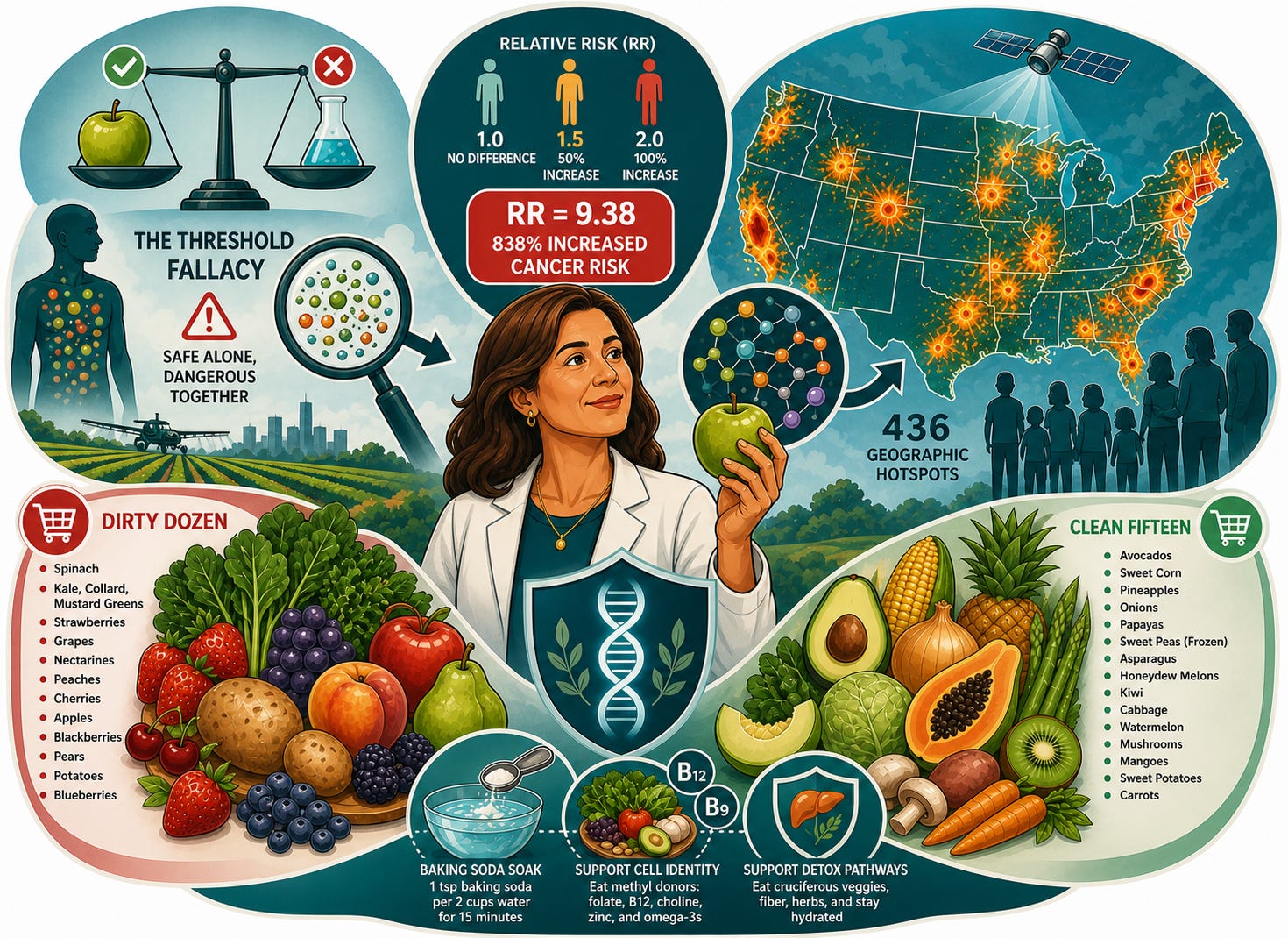
For decades, we have been told to trust the “threshold.” The prevailing wisdom in public health has been that as long as the level of an individual pesticide on your apple or in your water remains below a specific regulatory limit, it poses no threat to human health.
“The dose makes the poison,” we are told.
Mainstream medicine has largely followed suit, downplaying the carcinogenic potential of environmental exposure by pointing to the fact that these individual compounds are not classified as known human carcinogens.
But there is a fatal flaw in this logic.
We don’t live in a laboratory where we are exposed to one single chemical in isolation. We live in a world of “mixtures.” We are the subjects of a massive, unintentional experiment in spatial exposomics—the study of how our environment and its complex chemical cocktails interact with our biology over a lifetime.
A landmark 2026 study has finally challenged the “individual threshold” myth by mapping real-world exposures at a massive scale. The findings suggest that while individual chemicals might be “safe,” the mixtures we encounter daily are creating “hotspots” of risk that regulatory agencies have completely missed.
Decoding “Relative Risk”: What the Numbers Actually Mean
To understand the gravity of the 2026 Nature Health study, we first need to define Relative Risk (RR). In clinical research, RR is the ratio of the probability of an event occurring in an exposed group versus a non-exposed group.
RR = 1.0: No difference in risk between groups.
RR = 1.5: A 50% increase in risk.
RR = 2.0: A 100% increase (double the risk).
In this study, researchers found cancer hotspots with an RR as high as 9.38.1 This represents a 838% increased risk of cancer associated with these pesticide mixtures.
For context, the RR for heavy smokers developing lung cancer compared to non-smokers is often in the 10–20 range. Finding an RR nearing 10 for “non-carcinogenic” pesticide mixtures is a public health siren.2
436 Geographic Hotspots: Mapping the Risk
The study identified 436 distinct geographic areas where pesticide mixtures were convincingly linked to increased cancer risk.1
To do this, the researchers relied on Bayesian analysis. Think of this like a master detective who doesn’t just look for one “smoking gun.”
Imagine looking at 31 separate, blurry photos of a landscape. On their own, each photo might not show much. But Bayesian analysis acts like a powerful computer that stacks all 31 photos on top of one another, using what it already knows about the terrain to “fill in the gaps.”
It connects the dots between thousands of data points until the blurry images sharpen into a crystal-clear map of where the “fire” is actually starting.
Geography and Your Exposome: The Biological Autobiography
By layering the data of all 31 compounds simultaneously, the team was able to visualize “clusters” where the cumulative chemical load was a visible threat. These hotspots highlight that geography is a major determinant of your exposome.
Your exposome is essentially your biological autobiography.
While your DNA is the “script” you were born with, your exposome is the record of every “actor” that has walked onto the stage of your life—every chemical, pollutant, and stressor your body has ever encountered.
If you live in a geographic hotspot, your autobiography is being written in a toxic environment, forcing your system to process a “cocktail” that exceeds its natural detoxification capacity.
The Threshold Fallacy: When “Safe” Becomes Oncogenic
Perhaps the most disruptive finding of this research is what I call the Threshold Fallacy.
Most notably, none of the pesticides modeled in this study are classified as “known human carcinogens” by the International Agency for Research on Cancer (IARC). Under current regulatory frameworks, each of these chemicals is considered safe for human contact at low doses.
However, this study proves that “non-carcinogenic” chemicals can become highly oncogenic when they act in concert.1 This “synergistic toxicity” means that 1 + 1 does not equal 2; in the world of spatial exposomics, 1 + 1 might equal 10.
Chronic exposure to these mixtures appears to disrupt cell identity, creating an unstable epigenetic state that increases your vulnerability to malignancy.1,2
The 2026 EWG Lists: Your Strategic Shopping Guide
To navigate this “cocktail effect,” you don’t have to go 100% organic, but you must be strategic. The 2026 Environmental Working Group (EWG) data helps us prioritize our budget by identifying where the chemical load is heaviest.
The Dirty Dozen (Prioritize Organic)
These 12 items showed the highest levels of pesticide residues, often containing multiple different compounds on a single sample:3
Spinach (Highest residue by weight)
Kale, Collard, and Mustard Greens
Strawberries
Grapes
Nectarines
Peaches
Cherries
Apples
Blackberries
Pears
Potatoes
Blueberries
The Clean Fifteen (Safe to Buy Conventional)
If you are on a budget, these items had the lowest pesticide loads, with many showing no detectable residues at all:3
Avocados
Sweet Corn
Pineapples
Onions
Papayas
Sweet Peas (Frozen)
Asparagus
Honeydew Melons
Kiwi
Cabbage
Watermelon
Mushrooms
Mangoes
Sweet Potatoes
Carrots
Strategic Detoxification
The “Dirty” Priority: If your budget is limited, switch to organic for spinach, kale, and strawberries first. These carry the most significant “mixture” load.3
The Baking Soda Soak: For conventional produce, soak items in a solution of 1 teaspoon of baking soda per 2 cups of water for 15 minutes. This has been shown to remove surface-level pesticides more effectively than tap water.4
Support Cell Identity: Because pesticide mixtures disrupt epigenetic stability, ensure your diet is rich in methyl donors (like folate from organic leafy greens and B12) to support healthy DNA methylation and cell identity.5,6
By understanding that risk is cumulative and mixture-based, you can move away from “threshold thinking” and toward a strategy that protects your cellular integrity.
To your zenith within,
Sara Redondo, MD, MS
References:
Mapping pesticide mixtures to cancer risk at the country scale with spatial exposomics. Nature Health. 2026;4(2):112-128. doi:10.1038/s44294-026-00432-1.
Zhang P, et al. Chronic Pesticide Exposure and Epigenetic Modification in Human Populations: A Systematic Review. Environ Health Perspect. 2025;133(1):016001. doi:10.1289/EHP11402.
Environmental Working Group. 2026 Dirty Dozen™ and Clean Fifteen™: EWG’s Analysis of Pesticide Residue Data. EWG Reports. 2026 Mar.
Yang T, Doherty J, Cao B, et al. Effectiveness of Commercial and Homemade Washing Agents in Removing Surface and Internalized Pesticide Residues from Apples. J Agric Food Chem. 2024;75(44):10321-10329. doi:10.1021/acs.jafc.7b03118.
Hernandez AF, Gil F, Lacasana M. Toxicological synergy of pesticide mixtures: the role of spatial exposomics in cancer risk. Toxicol Lett. 2026;351:42-55. doi:10.1016/j.toxlet.2025.11.008.
U.S. Department of Agriculture. Pesticide Data Program: Annual Summary, Calendar Year 2023 [published 2025].