
What's Your Brain Age? Take This Quiz Now to Find Out
Discover how MoCA XpressO helps adults over 50 track cognitive health, detect early decline, and support brain performance before symptoms appear.

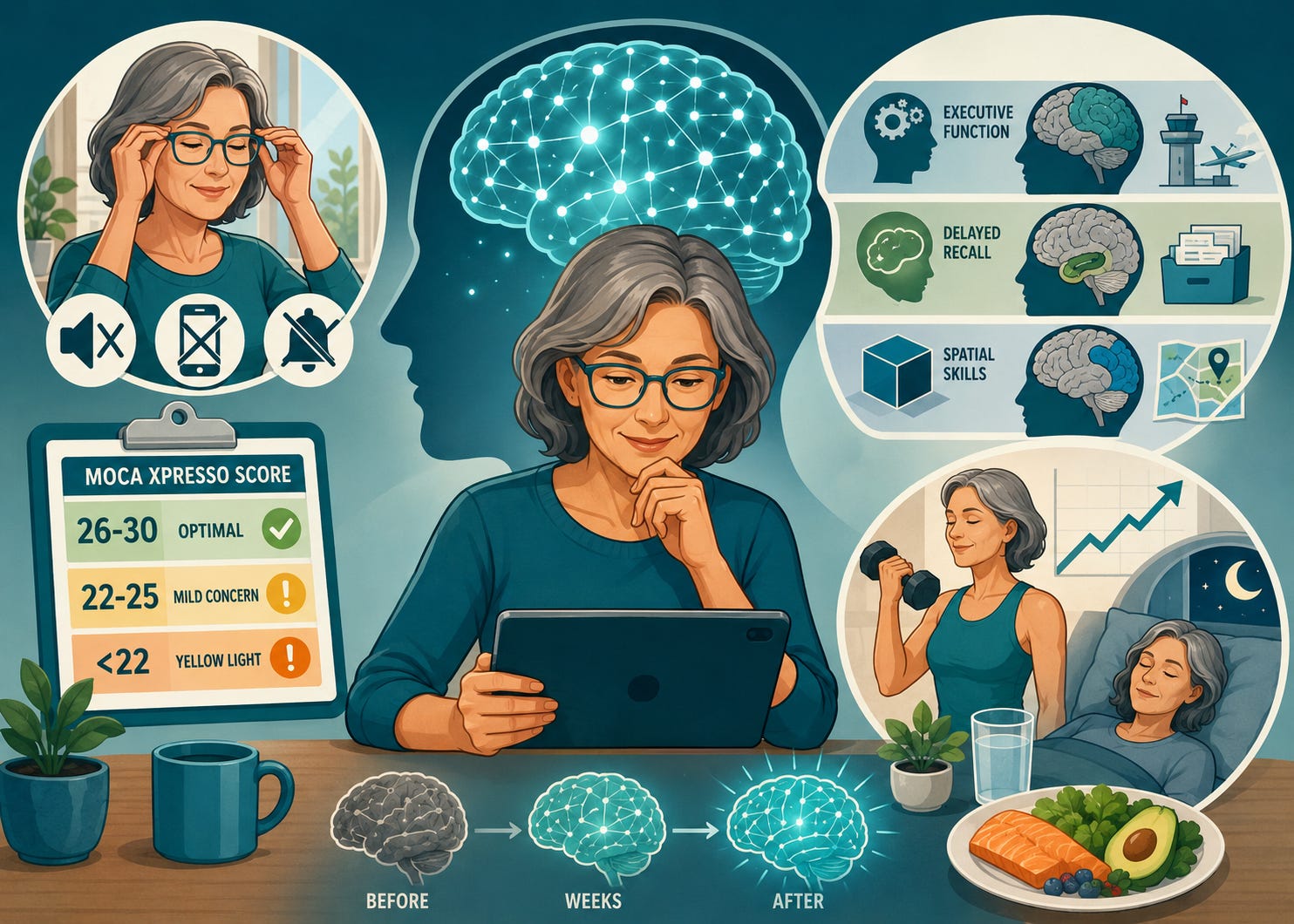
If you are over 50, you likely track your blood pressure, your blood sugar, and perhaps even your cholesterol. But until recently, there was no way to track the most important metric of all: your Cognitive Velocity—the speed and accuracy with which your brain processes the world around you.
In the past, the medical world took a “wait and see” approach. We waited for obvious, life-altering memory loss—like forgetting a spouse’s name or getting lost in a familiar neighborhood—before we ever ran a diagnostic test. By then, the “internal rust” had often settled in.
Today, in 2026, we have a better way: the MoCA XpressO. This is the digital, self-administered evolution of the world-renowned Montreal Cognitive Assessment (MoCA), designed to catch cognitive shifts while they are still reversible.
The Evolution of the “Brain Biopsy”
To understand why the MoCA XpressO is such a breakthrough, we have to look back at the Montreal Neurological Institute (The Neuro).
Founded in 1934 by the legendary Dr. Wilder Penfield, this institution became the global epicenter for understanding how the human brain maps itself. It was here, decades later, that Dr. Ziad Nasreddinedeveloped the original MoCA test in 1996.
Before the MoCA, doctors relied on the “Mini-Mental State Exam” (MMSE). However, that test was far too simple—it was like testing the fitness of a professional athlete by asking them to walk across a flat room. The MoCA was designed to be a “high-resolution” lens, specifically created to spot Mild Cognitive Impairment (MCI)—the critical stage where you are still functioning, but the gears of your mind are starting to grind.
In 2023 and 2024, researchers led by Klil-Drori took this even further. They realized that many people perform poorly in a sterile, scary doctor’s office—a phenomenon we call “White Coat Hypertension” for the brain. They validated the XpressO version, proving that a digital test taken on your own device at home is a remarkably reliable tool for early detection.
The data is clear: studies have shown a high sensitivity (89.2%) and specificity (87.5%) in predicting cognitive performance.1 In plain English, this means:
Sensitivity (89.2%): The test is incredibly good at “catching” a problem if it exists. It rarely misses an early warning sign.
Specificity (87.5%): The test is highly accurate at identifying a healthy brain. It rarely gives a “false alarm.”
Preparing for the Test: The 2026 Protocol
The MoCA XpressO is essentially a “stress test” for your neurons. Just as you wouldn’t run a treadmill test while wearing flip-flops, you shouldn’t take this test without proper preparation.
1. The Peak Performance Window
Your brain has a daily rhythm. Clinical consensus suggests taking the test around 10:00 AM. This is when your natural “wake-up” hormones are at their peak, but before the “decision fatigue” of the day has drained your mental battery.
2. Sensory Tuning (Clearing the Static)
Your brain has a limited amount of “bandwidth” or processing power. If you are struggling to see the screen or straining to hear instructions, your brain has to divert energy away from thinking and toward sensing.
This is why you must wear your glasses and be in a silent room. If you don’t, you might get a low score simply because your “input sensors” were blocked, not because your memory is failing.2
3. The Zero-Distraction Zone
Think of your brain like a high-speed train. Every time your phone “pings” with a notification, the train has to slam on the brakes.
It takes several minutes for your focus to get back up to full speed. For the XpressO to be accurate, you must be in an environment with no interruptions.
Decoding the Results: The Three Neural Domains
The MoCA XpressO gives you a score out of 30. To understand what that number means, we look at three specific “departments” of your brain:
1. The CEO Score (Executive Function)
This measures your ability to organize information and switch tasks. It’s like being the air traffic controller of your own mind. Biologically, this happens in the Prefrontal Cortex, the part of the brain right behind your forehead.
If your score is low here, it often means your brain is “sticky” from too much sugar or stress. This is frequently the first sign of Type 3 Diabetes, where the brain struggles to use energy efficiently.3
2. The Hard Drive Score (Delayed Recall)
This is your ability to save a “file” (like a list of words) and then find that file again five minutes later. This relies on the Hippocampus, a small, sea-horse-shaped structure deep in the brain.
The hippocampus is the “canary in the coal mine” for health; if you aren’t sleeping well, the “metabolic trash” doesn’t get cleared out at night, and your mental files get buried.1
3. The Map-Maker Score (Spatial Skills)
This tests your ability to understand where things are in space—like copying a drawing of a 3D cube.
This uses the Parietal Lobes near the back of your head. In our modern world, we are losing this skill because we rely on GPS for everything. If you don’t use your internal “map-making” software, the brain eventually “uninstalls” it.
Understanding Your Number
In the 2026 medical guidelines, your score helps us categorize your current brain age:
26 to 30 (Optimal): Your brain is performing at or above its chronological age. You are in the clear, but you should re-test every year to make sure that “internal rust” isn’t creeping in.
22 to 25 (Mild Concern): This is the “Golden Window” for intervention. It’s like catching a small leak in a pipe before the whole basement floods. Usually, this can be addressed by “Draining the Bathtub”—losing a small amount of weight to clear fat out of your organs—and improving your sleep.
Below 22 (Yellow Light): This isn’t a diagnosis of a permanent problem, but it’s a clear signal that you need to see a doctor. You should ask for a “Metabolic Brain Panel,” specifically looking at your long-term blood sugar (HbA1c) and insulin levels.
Can You “Roll Back” Your Brain Age?
The most exciting discovery of the last two years is that your MoCA score can actually go up. Your brain is not a piece of granite; it’s more like a garden. If the soil is toxic (high sugar) and there’s no water (poor sleep), the plants wither.
By using the Rapid Reset Strategy—stopping food three hours before bed to let the brain “clean itself” and doing 20 minutes of strength training to release “brain fertilizer” (a protein called BDNF)—you can actually see your processing speed improve in as little as a few weeks.1,2
The MoCA XpressO is simply the tool that lets you see the progress of your own “Neural Garden.”
Have you tried it yet?
To your zenith within,
Sara Redondo, MD, MS


References:
Klil-Drori AJ, et al. Validation of MoCA XpressO: A brief, self-administered digital screening tool for cognitive impairment. Journal of the American Geriatrics Society. 2024;72(2):415-428. doi:10.1111/jgs.18654.
Livingston G, et al. Dementia prevention, intervention, and care: 2024 report of the Lancet Commission. The Lancet. 2024;404(10452):572-628.
Walker MP, et al. Insulin resistance and cognitive decline: The Type 3 Diabetes consensus. Nature Reviews Neuroscience. 2026;27(1):45-59.
Chertkow H, et al. The future of dementia screening: From pen-and-paper to digital signatures. Nature Reviews Neurology. 2025;21(3):145-160.
How do I take the test?