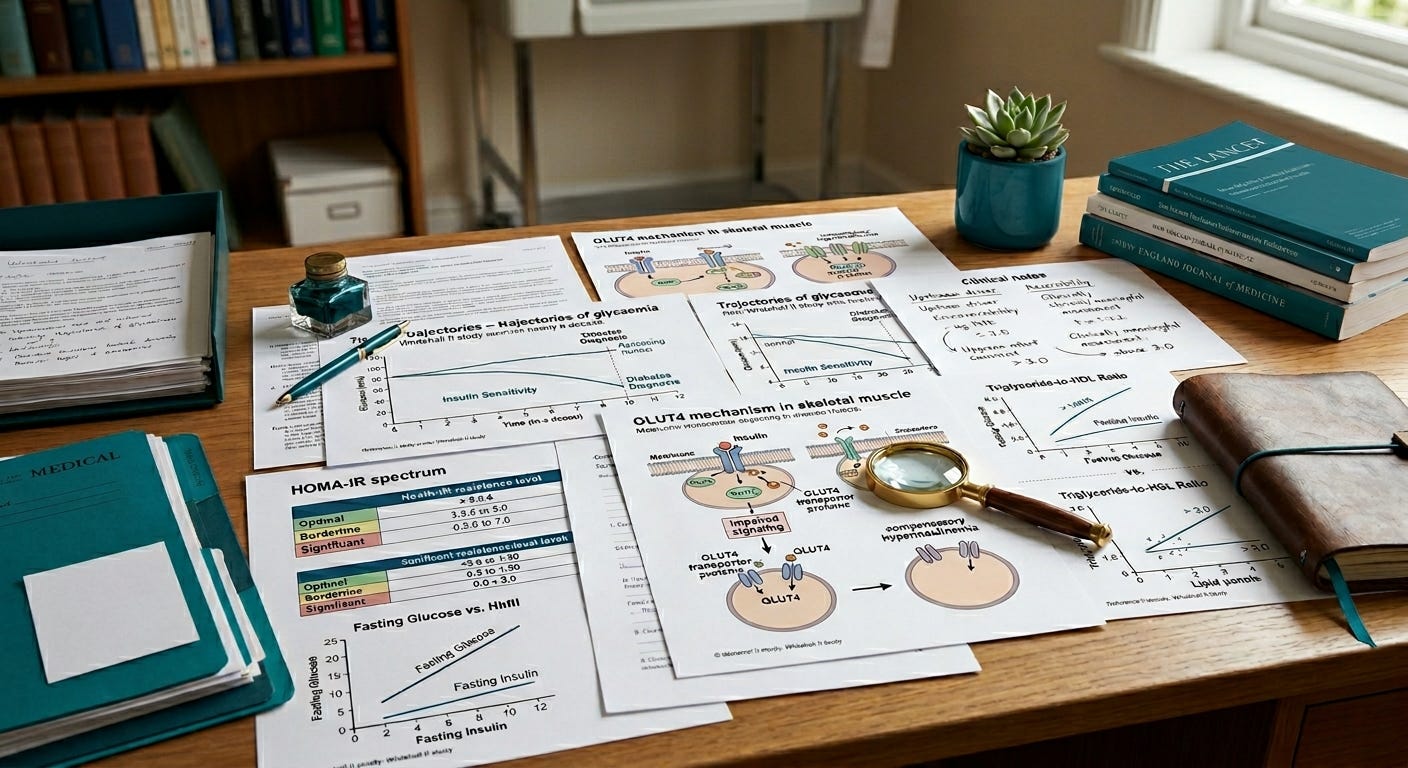
Your fasting glucose was normal at your last check-up. Your doctor didn’t flag anything. You have no diagnosis. Here’s what that result probably missed.
Insulin resistance — the impaired ability of cells to respond to insulin’s signal to absorb glucose — doesn’t announce itself. It develops gradually, over years. And crucially, it develops long before fasting glucose becomes abnormal.
A landmark prospective analysis of 6,538 adults followed for nearly a decade found that markedly reduced insulin sensitivity was detectable more than 10 years before a diabetes diagnosis was made, during which time fasting glucose remained in the normal range throughout.¹
That number is worth sitting with. A decade of a process building, tissues adapting, metabolic function shifting, with a standard annual blood test showing nothing of note.
Most people find out they have a problem when it has already progressed past the point where intervention is easiest. This post is about finding out before that.
How Insulin Resistance Develops
Insulin’s primary job is to signal cells — mainly in skeletal muscle, the liver, and fat tissue — to absorb glucose from the bloodstream after a meal. It does this by binding to insulin receptors on cell surfaces, triggering a cascade that moves glucose transporters (specifically a protein called GLUT4, or glucose transporter type 4) from inside the cell to the cell membrane. Once at the membrane, GLUT4 lets glucose in.
In insulin resistance, this process is impaired. The insulin signal arrives, but the cellular response is blunted. GLUT4 doesn’t move efficiently. Glucose stays in the bloodstream longer. The pancreas detects this and responds by producing more insulin — compensating for the weak signal by turning up the volume.² This is compensatory hyperinsulinemia, and it’s the first stage of insulin resistance. At this point, blood glucose is still entirely normal. Fasting glucose is fine. Only fasting insulin would reveal what’s happening.
Over years, the compensation continues. The pancreas works harder and harder to maintain normal glucose levels. Fasting insulin climbs. HOMA-IR (Homeostasis Model Assessment of Insulin Resistance — a calculated index using fasting insulin and fasting glucose) rises. Eventually, the pancreas can’t fully compensate. Fasting glucose begins to creep up. The person enters the prediabetes range. Without intervention, this progresses to type 2 diabetes — the point at which the pancreatic beta cells that produce insulin have been so chronically overworked that their capacity is permanently reduced.²
The progression is a spectrum. And at every stage before end-stage beta cell failure, it’s reversible.
Why Insulin Resistance Matters Well Beyond Diabetes
Insulin resistance is often framed as a diabetes precursor. That framing understates it considerably.
Insulin resistance is the upstream driver of most of the chronic diseases that shorten and diminish adult life. Cardiovascular disease. Metabolic dysfunction-associated steatotic liver disease — the condition formerly called non-alcoholic fatty liver disease, now the most common liver disease globally. Cognitive decline and Alzheimer’s disease, in which impaired insulin signaling in the brain is now recognized as so central that some researchers describe it as “type 3 diabetes.” Polycystic ovary syndrome (PCOS). Several cancers, including colorectal, pancreatic, and endometrial, for which insulin and insulin-like growth factor signaling are established tumor-promoting pathways.
None of these conditions are caused solely by insulin resistance. All of them are substantially driven by it. And in the majority of adults who develop them, insulin resistance has been present for years before the diagnosis.
This is why the question of where you sit on the insulin resistance spectrum is one of the most clinically important questions in preventive medicine. And it’s one that most standard check-ups don’t answer.
In the rest of this post, we’ll make that question practical. We’ll go through the insulin resistance spectrum — from optimal insulin sensitivity to prediabetes — and the markers that help distinguish early compensation from meaningful metabolic dysfunction. We’ll cover the tests that can detect insulin resistance before fasting glucose changes, the symptom patterns people often dismiss as “normal aging” or “just being tired,” and the evidence-backed interventions that most consistently improve insulin sensitivity. By the end, you’ll know what to look for, what to ask for, and which levers actually move the needle.
I’ve put together a downloadable assessment — a scored tool covering the symptoms, risk factors, and lifestyle inputs that together indicate where someone is likely to sit on the spectrum. It includes the specific tests to request, what the numbers mean, and what scores to aim for. Paid subscribers will find it at the end of the post.