

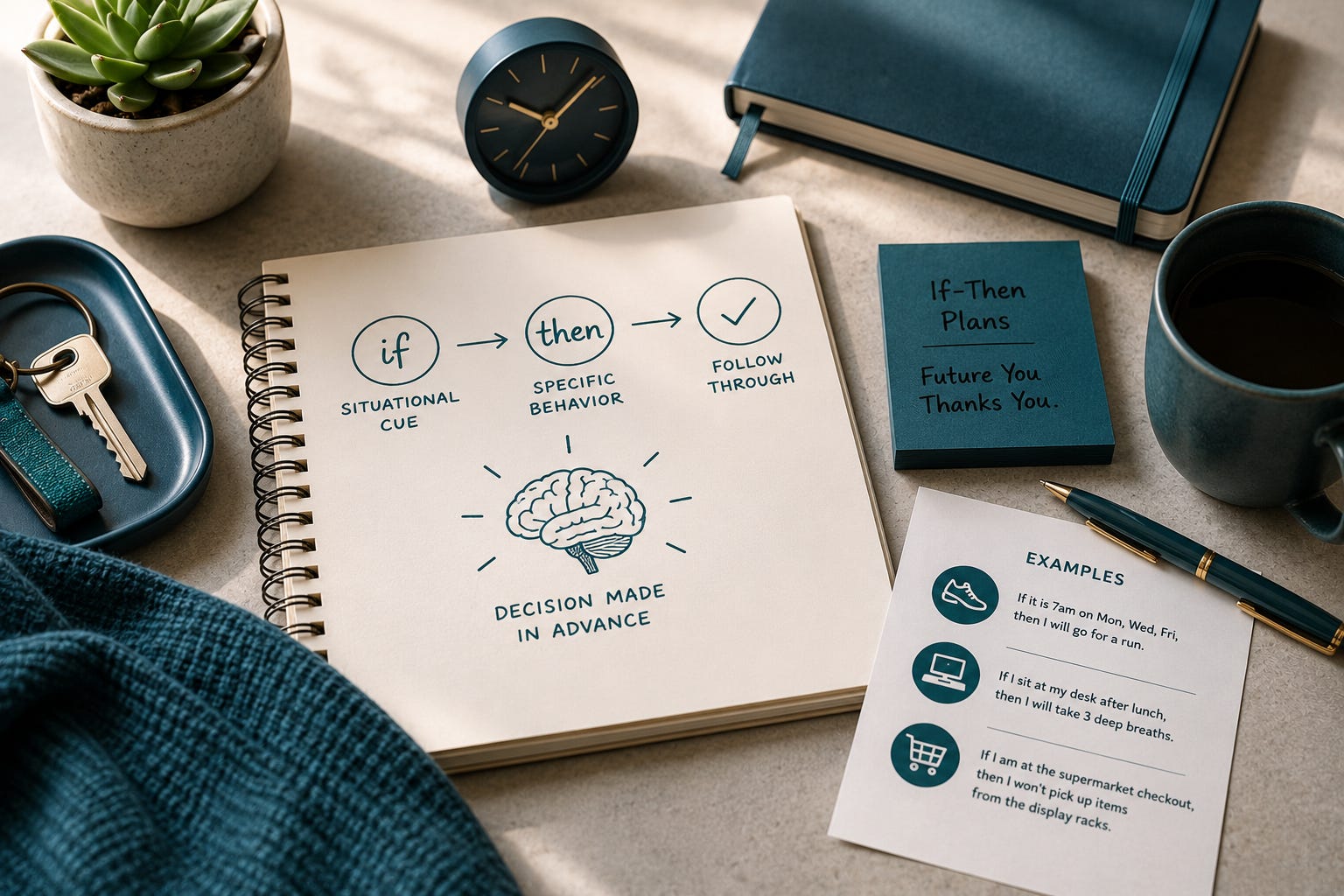
Most people who fail to exercise regularly, eat better, or sleep more don’t have a motivation problem. They have an architecture problem. They know what they want to do. They don’t have a plan for when and how they’re going to do it, and so when the moment arrives, they’re starting the decision from scratch.
Research in behavioral psychology has identified one technique that consistently closes this gap, and the effect size is large enough to matter in practice: implementation intentions.
What an Implementation Intention Actually Is
An implementation intention isn’t a goal. A goal tells you what you want. An implementation intention tells your brain exactly when, where, and how you’re going to act on it.
The structure is a single if-then sentence:
“If [situational cue that already exists in my day], then I will [specific behavior].”
“If it is 7am on Monday, Wednesday, and Friday, then I will put on my running shoes and leave the house before doing anything else.”
“If I sit down at my desk after lunch, then I will take three deep breaths before opening email.”
“If I am at the supermarket checkout, then I won’t pick up anything from the display racks.”
The cue has to be something that already happens, a fixed point in your existing routine. The behavior has to be specific enough that there’s no decision to make in the moment. The whole point is that the decision gets made in advance, in a calm state, rather than in the moment when competing impulses have more power.
The Finding
Researchers Peter Gollwitzer and Paschal Sheeran analyzed 94 independent studies testing whether forming an implementation intention improves the rate of goal attainment compared to holding the same goal without a specific if-then plan.¹ The effect size was medium-to-large, meaning people who wrote an if-then plan followed through at substantially higher rates than those who only set a goal. The finding held across health behaviors, exercise, diet, academic performance, and interpersonal goals.
To put that in plain terms: the people who had a goal and wrote down exactly when, where, and how they planned to act on it were far more likely to actually do it than people who had the same goal and no specific plan.
Most behavioral interventions in health and psychology produce small effects. An effect of this size, replicated across 94 studies, is the kind of finding that is very hard to dismiss.
Why This Works
Think of the brain as having two distinct modes of operation. One mode is deliberate, effortful, and slow. It’s what makes the conscious decision whether to act. The other is automatic and fast: it fires in response to familiar cues without requiring a decision at all.
Most health behavior change advice targets the first mode. Set a goal, find your motivation, remind yourself why this matters.
The problem: in the moment the behavior is required, the deliberate system is often occupied with something else, tired, or overruled by immediate reward. The goal exists, but nothing triggers it.
Implementation intentions work by handing the behavior over to the automatic mode before the moment arrives. When you write “if it is 7am on Monday, the alarm goes off, then I put on my running shoes,” the alarm becomes a pre-wired trigger for that behavior rather than the start of a conscious debate. Research consistently shows that specified situational cues gain heightened salience after an if-then plan is formed, you notice the cue faster and respond to it more automatically.¹
The mechanism is structural, not motivational. It changes how the behavior gets initiated.
The paid section gives you everything you need to write one that actually works: the specific elements that determine whether a plan succeeds or fails, examples across exercise, eating, sleep, and supplements, how to write a second plan for the obstacle that has always stopped you before, and the research connecting this to habit formation. A downloadable if-then planning worksheet is at the end so you can build yours before you close the tab.
