
The Floor Test: Is Your “Biological Age” Older Than Your Passport?
Can you sit and stand without using your hands? This simple test predicts longevity and independence. Discover the science and how to improve.

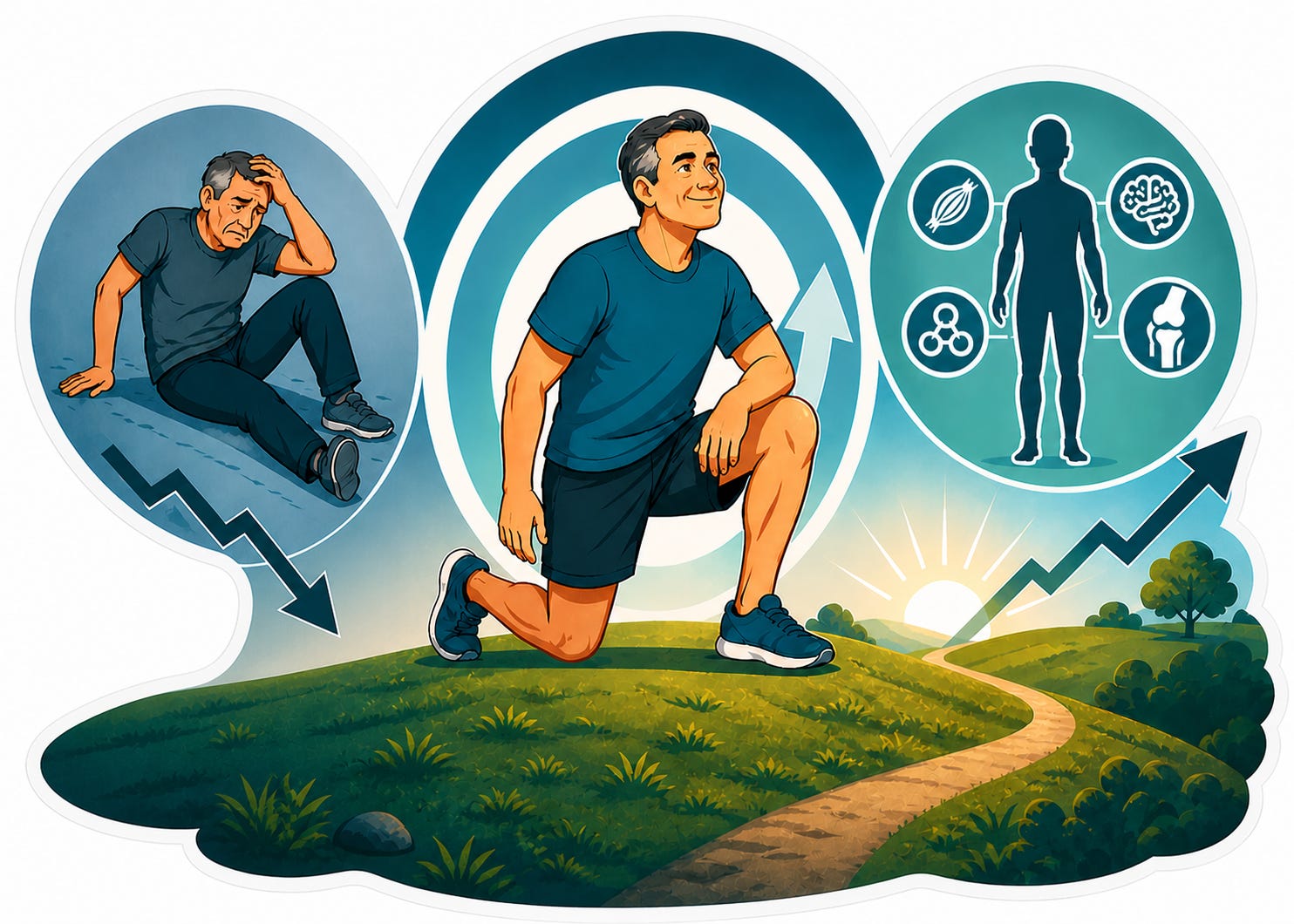
If I could ask you one question to predict how likely you are to be living independently ten years from now, it wouldn’t be about your cholesterol, your 10k run time, or your bench press.
It would be this:
Can you get down to the floor… and back up… without using your hands?
To most of us in our 30s or 40s, this sounds trivial. But as we age, the floor becomes a “foreign territory.”
We stop sitting on it, we stop playing on it, and eventually, we start to fear it. We outsource our mobility to chairs, couches, and elevated toilet seats, inadvertently letting the muscles and neurological pathways required for floor transitions wither away.
In clinical circles, we call this “functional capacity.” But a groundbreaking study has shown that our ability to navigate the distance between the floor and a standing position is actually a “crystal ball” for all-cause mortality.
It’s perhaps the most honest assessment of your musculoskeletal and neurological health currently available.
The data suggests that if you struggle with this movement today, your risk of death over the next six years is significantly higher than your peers—even if your bloodwork looks “perfect.”
The Science of the Sitting-Rising Test (SRT)
The most famous exploration of this was a study published in the European Journal of Preventive Cardiology. Researchers in Brazil followed 2,002 adults (ages 51–80) for an average of 6.3 years.1
The participants were asked to perform the Sitting-Rising Test (SRT): sit on the floor and stand back up using the minimum support necessary.
The Scoring: You start with 10 points. Every time a hand, knee, forearm, or side of the leg is used for support, you lose 1 point. Lose 0.5 points for a noticeable loss of balance.
The Results: Every 1-point increase in the SRT score was associated with a 21% improvement in survival. Those in the lowest scoring category (0–3 points) had a 5.4 times higher risk of death during the study period compared to those in the highest group (8–10 points).1
Why This Simple Move Predicts Death
Why is “floor mobility” such a potent predictor? It’s because the movement is a composite of four critical pillars of “Zenith Health”:
1. The Muscle Power Paradox
It isn’t just about strength; it’s about power. Muscle strength is the ability to lift a load; muscle power is the ability to do it quickly.
Research indicates that muscle power declines faster than muscle strength as we age and is a much more accurate predictor of functional independence and life expectancy.2
Getting off the floor requires a “burst” of power from the glutes and quads that a standard walk simply doesn’t demand.
2. The “Long Lie” Risk
Falling is a leading cause of accidental death in older adults. However, the greatest danger isn’t always the fall itself—it’s the “long lie.”
If an individual falls and lacks the functional mobility to get back up, they are at high risk for dehydration, pressure sores, and rhabdomyolysis (muscle breakdown).
Studies show that the inability to rise after a fall is a distinct clinical marker for a rapid decline in health.3
3. Proprioception and Neural Integrity
Getting from the floor to standing is a complex neurological task.
It requires the cerebellum to coordinate balance, the vestibular system to manage spatial orientation, and the peripheral nervous system to recruit motor units in a precise sequence.
A low SRT score is often an early “warning light” for declining neural integrity before cognitive symptoms even appear.4
Improving Your Floor Score
