

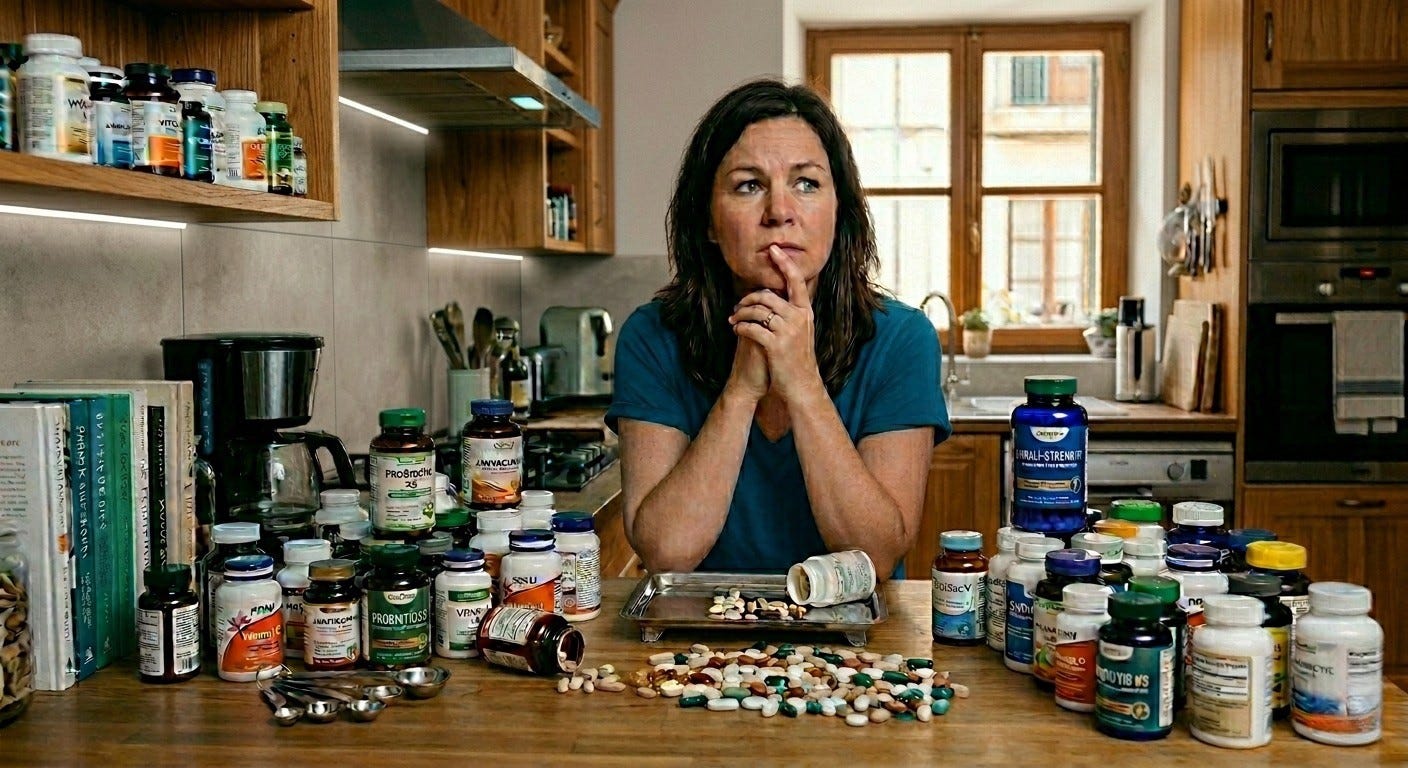
Three supplements. Three very different stories. Creatine has decades of rigorous research behind it. Probiotics are legitimate medicine for the right conditions, and mostly irrelevant noise for everyone else. Melatonin is a hormone your body already makes, being sold back to you in doses that may do more harm than good.
The supplement industry generated over $177 billion globally in 2023, and a sizeable portion of that revenue comes from people who genuinely believe they are doing something smart for their health.1 Most of the time, the product works, just not for them, not in that dose, and not for that reason.
Here is what the current evidence actually says about three of the most widely purchased supplements on the market.
Creatine: The One That Actually Earns Its Reputation
Most supplements have a gap between their marketing and their science. Creatine is the rare exception where the science is genuinely strong, with the gap running in the other direction: the research may actually justify a broader audience than the supplement industry is currently targeting.
What It Is
Creatine is not a synthetic compound invented in a lab. It is an amino acid derivative naturally synthesized in the liver, kidneys, and pancreas from arginine, glycine, and methionine. The body requires roughly 2 to 4 grams per day, approximately half of which comes from dietary sources such as red meat and seafood; the remainder is produced endogenously.2 Most of the body’s creatine is stored in skeletal muscle in the form of phosphocreatine, which serves as a rapid-access energy buffer for high-intensity activity.
Who Actually Benefits
The most robust evidence applies to athletes and people who lift weights. A 2024 systematic review and meta-analysis examining adults under 50 confirmed that creatine supplementation combined with resistance training produces meaningful gains in upper- and lower-body strength.3 This is not a new finding. What is newer is the growing recognition that this same mechanism, supporting phosphocreatine availability in muscle tissue, is clinically relevant for aging adults, not just young athletes.
A 2025 review published in the Journal of the International Society of Sports Nutrition made the case that creatine monohydrate should be considered a conditionally essential nutrient for older adults, with documented applications for managing age-related sarcopenia, osteoporosis, and frailty.2 Muscle strength declines progressively after middle age, and the consequences, including falls, fractures, and loss of independence, are well established. Creatine, particularly when combined with resistance training, consistently slows this trajectory.4
There is also an emerging body of evidence on brain health. Creatine crosses the blood-brain barrier and increases cerebral phosphocreatine stores. A 2024 systematic review and meta-analysis found positive effects on memory function in adults, with the evidence rated as moderate certainty, a relatively high bar in nutrition research.5 Effects on processing speed, attention, and executive function showed lower certainty and require further investigation. The most consistent benefits appear in conditions of metabolic stress, such as aging and sleep deprivation.
Vegetarians and vegans, who obtain virtually no dietary creatine, have lower baseline muscle creatine stores and may respond more markedly to supplementation. This population is systematically underrepresented in the creatine literature but represents a group for whom supplementation has a clear physiological rationale.6
Who Probably Doesn’t Need It
Healthy young adults who eat sufficient animal protein and are not training with a goal of maximizing strength output are unlikely to see meaningful results. The body is already saturating its creatine stores through diet and endogenous synthesis. Adding more does not produce proportional gains.
Creatine is also not a fat-loss tool, a cardiovascular supplement, or an endurance enhancer. The mechanism is specific to short-duration, high-intensity work. Using it as a general wellness supplement without a training program attached is paying for a benefit that will not materialize.
Dosing and Safety
The evidence supports 3 to 5 grams of creatine monohydrate per day as a maintenance dose, with optional loading phases for rapid saturation (20 grams per day divided into four doses over five to seven days). Creatine monohydrate remains the best-studied and most cost-effective form; there is no consistent evidence that alternative forms outperform it. Long-term safety data is strong. Common concerns about kidney damage in healthy individuals are not supported by the current literature.
Probiotics: Highly Effective, Deeply Misunderstood
Probiotics may be the most oversold supplement category in existence, not because they don’t work, but because they work for specific conditions in specific people, and the industry markets them as broadly beneficial for everyone. The two categories are not the same thing.
What They Are
Probiotics are live microorganisms that, when administered in adequate amounts, confer a health benefit on the host. The key word is “specific”: efficacy is strain-specific, dose-specific, and condition-specific. A product containing Lactobacillus rhamnosus GG for one indication does not provide evidence that every Lactobacillus product works for every condition. This is the fundamental mistake most consumers make when reading probiotic labels.
Where the Evidence Is Strong
The clearest evidence supports probiotic use during antibiotic therapy. Antibiotics disrupt the gut microbiome by eliminating both pathogenic and commensal bacteria, which can result in antibiotic-associated diarrhea (AAD), a complication affecting between 5% and 35% of antibiotic users depending on the drug type.7 A 2025 meta-analysis of randomized controlled trials confirmed that probiotics, particularly multi-strain combinations, significantly reduce AAD incidence.8
Irritable bowel syndrome (IBS) represents another well-studied indication. A systematic review and meta-analysis published in Gastroenterology in late 2023, covering trials through March 2023, found that some probiotics were more effective than placebo for global IBS symptoms, abdominal pain, and bloating.9 A separate 2024 meta-analysis of 20 randomized controlled trials involving over 3,000 patients reported similar findings.10 However, the heterogeneity across studies is high, and the authors note that conclusions about specific strains are difficult to draw. Not every probiotic works for every IBS patient.
Where the Evidence Is Weak
A 2024 review by the International Scientific Association for Probiotics and Prebiotics (ISAPP) specifically examined whether healthy people should take probiotics as a general preventive measure. Their conclusion was measured: the evidence does not currently support a population-level recommendation for healthy individuals.11 Some indications showed suggestive benefits, including modest reductions in respiratory infection incidence, but the certainty of evidence was too low to justify routine supplementation across the board.
The bloated market of “immune support” and “gut health” probiotic products aimed at generally healthy consumers is not well supported by the clinical data. The gut microbiome of a healthy adult with a diverse diet and no gastrointestinal complaints is not obviously improved by daily probiotic supplementation. Fermented foods such as yogurt, kefir, kimchi, and sauerkraut provide a broader range of microbial diversity than most commercial probiotic capsules and have a stronger base of observational evidence for general gut health.
Who Should Consider Them
The practical shortlist for evidence-backed probiotic use includes: people taking a course of antibiotics (especially broad-spectrum), people with confirmed IBS, and people with a history of recurrent urinary tract infections. For each of these situations, choosing a well-studied, strain-specific product matters. Dosing a generic multi-strain capsule and expecting broad systemic benefits is not what the evidence supports.
Melatonin: You’re Probably Taking Too Much of Something Your Body Already Makes
Melatonin sits in an unusual category: it is not a nutrient, a plant extract, or a compound your body lacks. It is a hormone your pineal gland synthesizes every evening in response to darkness. Supplementing a hormone your body is already producing, at doses that can be ten to fifty times higher than physiological levels, is a different proposition than taking a vitamin or an amino acid, and one that deserves more scrutiny than most consumers give it.
What It Is and What It Does
Endogenous melatonin is produced in response to light suppression via the retinohypothalamic tract. Darkness triggers pineal release; light suppresses it. The hormone acts on MT1 and MT2 receptors in the suprachiasmatic nucleus to inhibit wake-promoting signals and advance sleep onset.12 Its role is fundamentally chronobiological: it tells the body what time it is, not simply whether to sleep. This distinction matters when evaluating whether supplementation is actually fixing the problem or just overriding it.
When It Is Clinically Justified
The strongest evidence for melatonin supplementation applies to circadian rhythm disorders, not generic insomnia. For delayed sleep-wake phase disorder, where a person’s biological clock is shifted two or more hours later than a conventional schedule, low-dose melatonin (0.5 mg) administered in the early evening produces a meaningful advance in sleep timing. For blind individuals with non-24-hour sleep-wake rhythm disorder, whose internal clock cannot synchronize to light-dark cycles, melatonin represents a genuine therapeutic option.
Jet lag is a well-documented application. Melatonin taken at the target bedtime of the destination reduces time-zone misalignment symptoms reliably across multiple reviews.13 Shift workers represent another population where melatonin has documented short-term utility for realigning sleep timing.
A meta-analysis published in 2021 found that melatonin improved subjective sleep quality in adults with respiratory diseases, metabolic disorders, and primary sleep disorders, but effects in individuals with mental health conditions were not significant. The improvements were modest: roughly 4 minutes of reduced sleep latency and around 13 minutes of additional sleep time in the insomnia trials.14
Why Routine Use Deserves More Skepticism
In the United States, melatonin is classified as a dietary supplement and sold over the counter in doses ranging from 0.5 mg to 10 mg or higher. A 2023 analysis found that 22 out of 25 commercially available melatonin gummy products were inaccurately labeled, with actual melatonin content ranging from 74% to 347% of the stated amount.15 One product contained no detectable melatonin at all. Dosing precision, which matters for a hormone, is not guaranteed by the current regulatory framework.
The American Academy of Sleep Medicine explicitly advises clinicians not to use melatonin for treating chronic insomnia in adults. The preferred evidence-based treatment remains cognitive behavioral therapy for insomnia (CBT-I), which produces durable improvements without hormonal intervention.16
Longer-term signals are emerging. A review of over 130,000 health records published by the American Heart Association reported an association between adults with insomnia who used melatonin for at least a year and a significantly higher likelihood of being diagnosed with heart failure compared to non-users. The association does not establish causation, and confounding by insomnia severity is a real concern, but it warrants attention for anyone taking melatonin nightly for months or years.17
What to Do Instead
Chronic insomnia in a person without a circadian rhythm disorder is most often a behavioral and environmental problem, not a melatonin deficiency. Morning light exposure within the first hour of waking, elimination of blue-light exposure in the two hours before bed, consistent sleep and wake times, and a cooler sleeping environment address the upstream drivers of the problem. These behavioral strategies do not come with a dose on the label, which is why they are rarely marketed as solutions, but they are what the evidence supports for long-term improvement.
The Bottom Line
Creatine is one of the most thoroughly validated supplements available, and its evidence base extends well beyond gym culture. If you are over 50, training with weights, or eating a plant-based diet, it deserves serious consideration.
Probiotics work for specific conditions. During antibiotic use or for managing IBS symptoms, targeted supplementation with a well-studied strain is clinically reasonable. As a general wellness product for a healthy adult with no gut complaints, the evidence does not make a compelling case.
Melatonin is most useful as a short-term chronobiological tool for jet lag, shift work, and diagnosed sleep phase disorders, not as a nightly habit. If you are taking 5 or 10 mg every night hoping it will solve chronic insomnia, you are taking pharmacological doses of a hormone, with imprecise labeling, for a problem the research says is better treated by changing your behavior.
Knowing the difference is not a minor detail. It is the difference between a supplement that earns its place in your routine and one that earns its place in the industry’s revenue forecast.
— Subscriber Content Below —
This article continues for paid subscribers. The full version includes evidence-based prevention protocols, strain-specific guidance, clinical decision thresholds, and a practical framework for deciding when each supplement earns a place in your routine and when it does not.